Our front page for December 7 — written and set by The Yesterday Times from the events below. Not an archival document.
Day of the year
341
Days left in 2026
24
In 2026 it falls on a
Monday
Star sign
Sagittarius
Birthstone
Turquoise
On December 7 in 1941, 85 years ago, Japanese Planes Bomb Pearl Harbor; 2,403 Dead in Surprise Raid. This page reports 11 stories from the date, 25 people born on this day.
The stories in full
War Desk
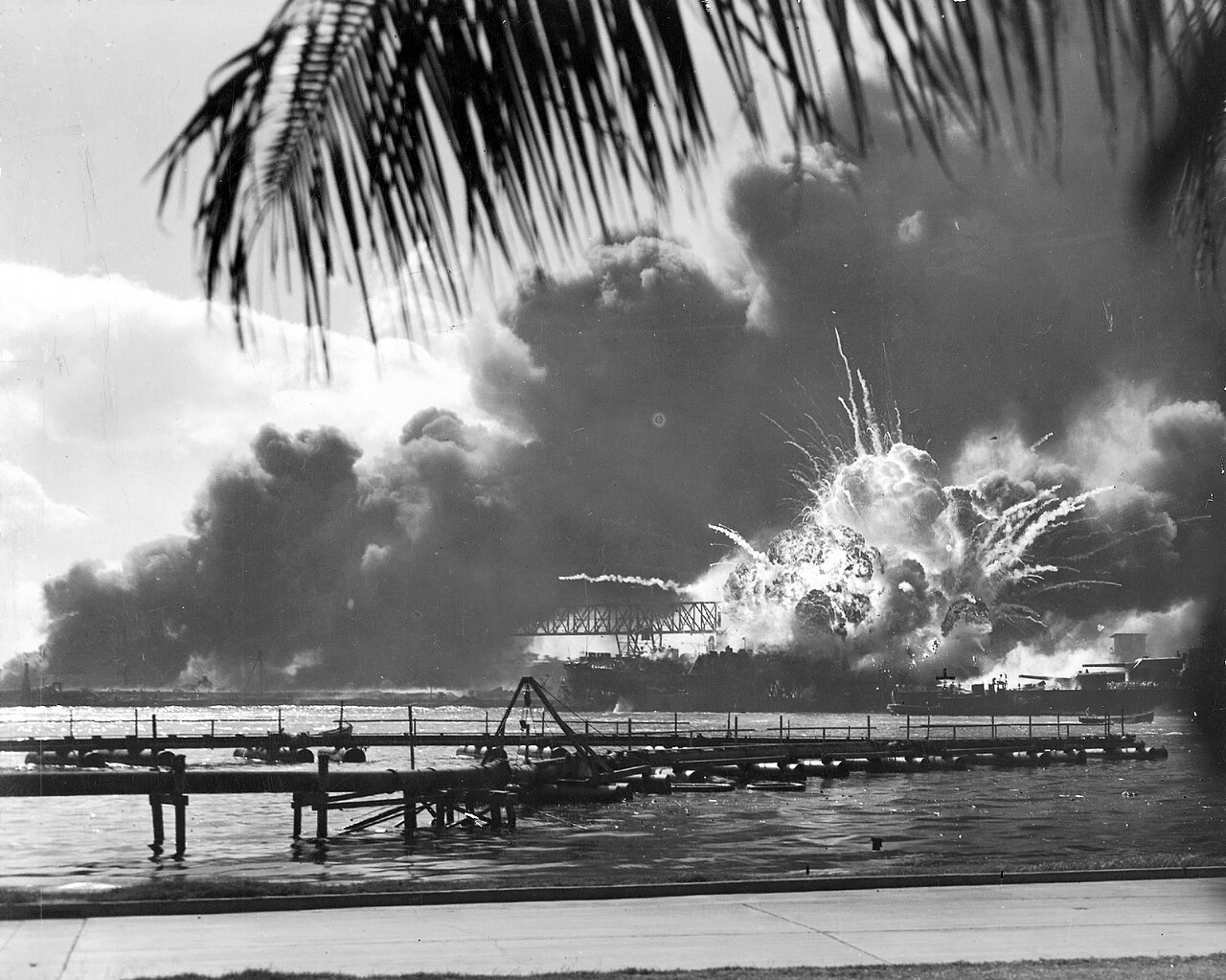
1941 — Japanese Planes Bomb Pearl Harbor; 2,403 Dead in Surprise Raid
Japan's surprise dawn attack kills 2,403 and wounds 1,178 in two waves of 353 planes.
The Japanese surprise attack on Pearl Harbor devastates the U.S. Pacific Fleet in Hawaii — navy photographer
PEARL HARBOR, Dec. 7 — The smoke still rises over Battleship Row this evening, and the harbor's waters are slick with oil and wreckage. The Imperial Japanese Navy, in a surprise dawn attack, has struck the U.S. Pacific Fleet and the Army and Marine airfields defending it, killing 2,403 Americans and wounding 1,178 others.
The attack came in two waves, totaling 353 fighters, level and dive bombers, and torpedo bombers, launched from six aircraft carriers. They caught the fleet at anchor, sinking or damaging battleships and cruisers and destroying hundreds of aircraft on the ground.
President Franklin D. Roosevelt, preparing to address Congress, called December 7, 1941, "a date which will live in infamy." War declarations are expected within hours.
Reports reaching this office confirm that Japan has also struck the U.S. possessions of the Philippines, Guam, and Wake Island, and has attacked British Malaya, Singapore, and Hong Kong. The Pacific is aflame from Hawaii to the South China Sea.
The full extent of the damage is still being assessed. Military officials have imposed strict censorship, and casualty figures are expected to rise as rescue and salvage operations continue through the night.
In Washington, the capital is tense, with officials moving between the White House and the War and Navy Departments. The nation, which had watched the war in Europe from afar, now finds itself at the center of it.
As darkness falls over the ruined harbor, the fires still burn.
Japan launched 353 fighters, level and dive bombers, and torpedo bombers in two waves from six aircraft carriers.
A total of 2,403 Americans were killed and 1,178 others were wounded in the attack.
President Franklin D. Roosevelt called December 7, 1941, 'a date which will live in infamy' before Congress.
The US declared war on Japan on December 8, 1941, with only Representative Jeannette Rankin dissenting.
Japan also attacked the US-held Philippines, Guam, and Wake Island, and British Malaya, Singapore, and Hong Kong.
Science Desk
1995 — Galileo Becomes First Craft to Orbit Outer
Probe arrives at Jupiter after six-year, 2.3-billion-mile journey.
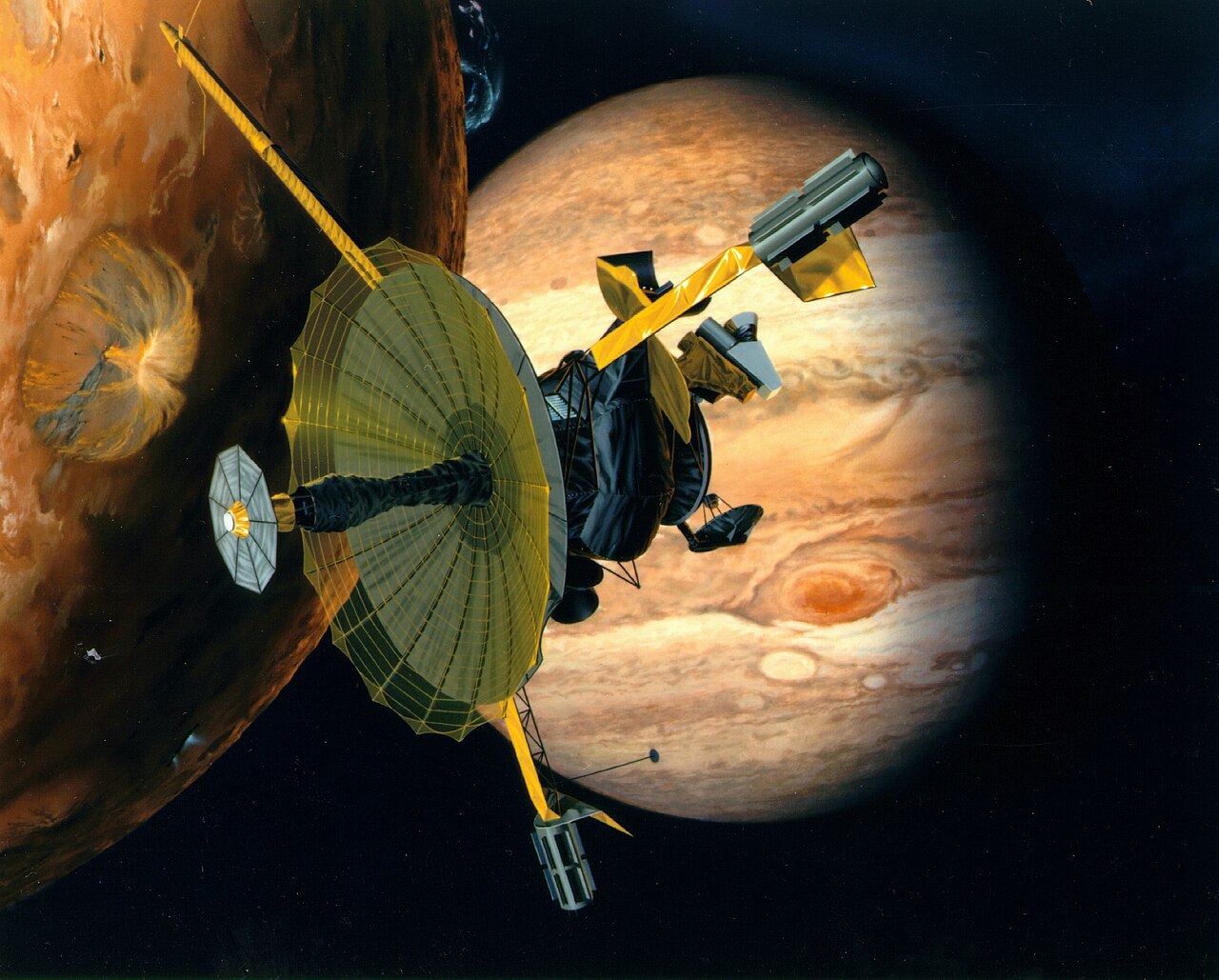
The Galileo spacecraft begins its historic mission to study Jupiter and its moons — NASA
PASADENA, Dec. 7 — A spacecraft from Earth has, for the first time, taken up residence around a planet of the outer solar system. Galileo, launched more than six years ago, fired its main engine this afternoon and slipped into orbit around Jupiter, ending a voyage of 2.3 billion miles.
The achievement makes Galileo the first artificial satellite of an outer planet. The craft, a joint project of NASA's Jet Propulsion Laboratory and West Germany's Messerschmitt-Bölkow-Blohm, carries an orbiter and an atmospheric probe that will descend into Jupiter's clouds in the coming weeks.
Galileo has a combined launch mass of 2,562 kilograms and stands 6.15 meters high. It was carried aloft on October 18, 1989, by the space shuttle Atlantis on mission STS-34.
One section of the spacecraft rotates at three revolutions per minute, holding six instruments that gather data from many directions. The orbiter will study Jupiter's atmosphere, magnetic field, and its four large moons for at least two years.
Scientists at JPL, which built and manages the spacecraft, hope the mission will unlock the secrets of the solar system's largest planet. The probe is expected to relay data until it is crushed by Jupiter's immense pressure.
The arrival marks the end of a long and troubled journey.
Galileo became the first spacecraft to orbit an outer planet upon arrival at Jupiter on December 7, 1995.
The spacecraft consisted of an orbiter and an atmospheric probe, with a combined launch mass of 2,562 kg and height of 6.15 m.
Galileo was launched on October 18, 1989, by Space Shuttle Atlantis during mission STS-34.
One section of Galileo rotated at three revolutions per minute, holding six instruments that gathered data from many directions.
The Jet Propulsion Laboratory built the spacecraft and managed the mission for NASA, with the propulsion module supplied by West Germany's Messerschmitt-Bölkow-Blohm.
Space Desk
2015 — Japan's Akatsuki Probe Enters Venus Orbit on Second Try
JAXA craft to study planet's thick atmosphere after five-year wait.
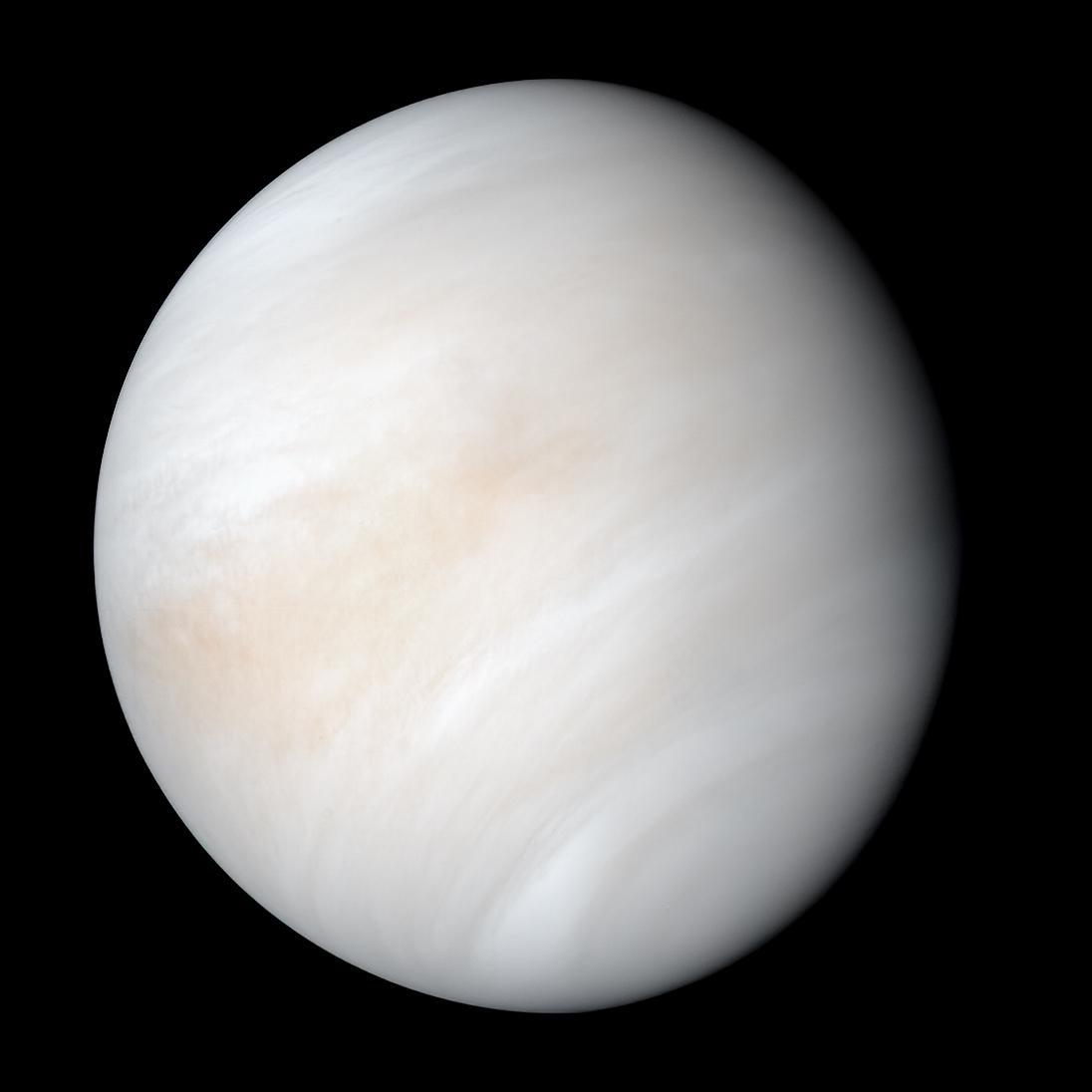
The Akatsuki probe captures Venus, marking its successful entry into the planet's orbit — NASA/JPL-Caltech
TOKYO, Dec. 7 — In the long, patient exploration of our sister planet, a second chance has finally arrived. Japan's Akatsuki probe, whose first attempt at Venus failed five years ago, has successfully entered orbit around the cloud-shrouded world, the Japan Aerospace Exploration Agency said today.
The uncrewed spacecraft fired its small engine Tuesday and slipped into a highly elliptical orbit around Venus, some 36 million miles from Earth. The maneuver, executed on autopilot because of the 16-minute signal delay, went off without a hitch, JAXA officials said.
Akatsuki, which means "dawn" in Japanese, is designed to study Venus's thick atmosphere, its super-rotating winds, and its mysterious lightning. The spacecraft carries five cameras and other instruments to map the planet's cloud tops and to track the movement of its weather systems.
The probe was launched in May 2010, but its first attempt to enter orbit in December of that year failed when the main engine shut down prematurely. Engineers managed to save the craft and devised a new plan, using small maneuvering thrusters to brake into orbit after a five-year circuit of the sun.
Japan's Akatsuki probe successfully entered orbit around Venus on December 7, 2015.
Akatsuki is an uncrewed robotic spacecraft designed to explore Venus and transmit scientific data back to Earth.
As an orbiter, Akatsuki will conduct long-term observation of Venus from orbit.
Rome Bureau
-43 — Cicero Slain, Head and Hands Nailed in Forum
Orator proscribed by triumvirs, executed while fleeing Italy.
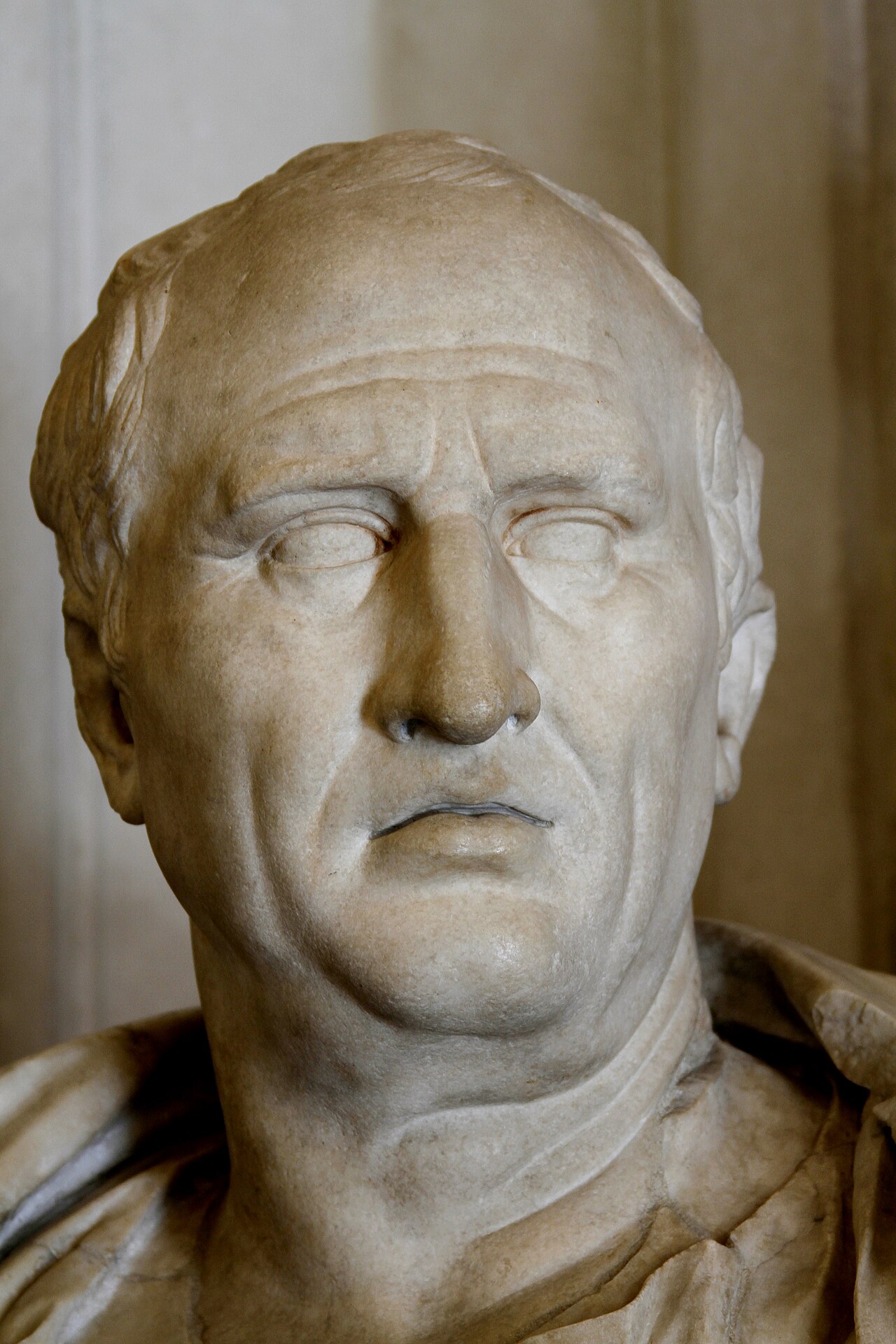
Marcus Tullius Cicero, the Roman orator proscribed and executed as an enemy of state — José Luiz
ROME, Dec. 7 — Marcus Tullius Cicero, the greatest orator of the age, is dead, his severed head and hands nailed to the Rostra in the Forum. He was proscribed as an enemy of the state by the Second Triumvirate and captured as he tried to flee Italy. The display serves as a grim warning for his Philippicae, the speeches that savaged Mark Antony. The proscription lists named some 2,000 men. Thus perished the voice of republican Rome.
Cicero was proscribed and executed on December 7, 43 BC while attempting to escape Italy for safety.
His severed hands and head were displayed on the Rostra by order of Mark Antony.
The Second Triumvirate's proscription lists named around 2,000 individuals, including Cicero.
Cicero's hands and head were displayed to represent repercussions for his anti-Antonian Philippicae speeches.
World Desk
1972 — Bormann Remains Found at Berlin Site
Skeleton identified as Hitler's deputy by dental records and skull photographs.
BERLIN, Dec. 7 — Construction workers have found the remains of Martin Bormann, the Nazi deputy who vanished at the end of the war, near Lehrter Station in West Berlin, ending a search that began with his conviction in absentia at Nuremberg.
Fragments of glass found in the jaws of both skeletons suggest suicide by cyanide capsules. Dental records reconstructed from memory in 1945 by Hugo Blaschke identified one skeleton as Bormann's. Composite photographs of skulls overlaid on photographs of faces were completely congruent.
The second skeleton was deemed to be that of Stumpfegger, Hitler's physician, based on similar height to his last known proportions.
On 7 December 1972, construction workers uncovered human remains near Lehrter station in West Berlin.
Fragments of glass were found in the jaws of both skeletons, suggesting suicide by cyanide capsules.
Dental records reconstructed from memory in 1945 by Hugo Blaschke identified one skeleton as Bormann's.
Composite photographs of skulls overlaid on photographs of faces were completely congruent.
The second skeleton was deemed to be Stumpfegger's, based on similar height to his last known proportions.
Cricket
1936 — Fingleton's Fourth Century Sets Record
Australian opener first to score centuries in four successive Test innings.
SYDNEY, Dec. 7 — Jack Fingleton, the Australian opener, today became the first player to score centuries in four consecutive Test innings, reaching three figures in the First Test of the 1936–37 series against England. Brown shared the stand, his opening partner for the streak. Australia won all three prior Tests by an innings.
Jack Fingleton scored a century in the First Test of the 1936–37 series to achieve the record.
Fingleton opened the batting with Bill Brown during his record streak.
Fingleton scored centuries in three consecutive innings as Australia won each of the last three Tests by an innings before the record.
Combined Operations
1942 — Canoe Raid Damages Six Ships at Bordeaux
Royal Marines in canoes damage six enemy ships in a night raid on Bordeaux.
LONDON, Dec. 7 — In the dark waters of the Gironde estuary, a handful of Royal Marines in canoes slipped past German patrols to strike at the port of Bordeaux, damaging six enemy ships in a daring raid.
The raid was carried out by the Royal Marines Boom Patrol Detachment (RMBPD), part of Combined Operations.
The raiders were inserted by the submarine HMS Tuna, commanded by Lieutenant-Commander Dick Raikes.
Only two of the ten men who launched from the submarine survived: Herbert 'Blondie' Hasler and Bill Sparks.
Six of the eight missing raiders were executed by the Germans, and two died from hypothermia.
Two German vessels were sunk and four others suffered varying degrees of damage in the attack.
Colonial Affairs
1837 — Rebellion Crushed at Montgomery's Tavern
Mackenzie's forces routed by British troops; leader flees north.
TORONTO, Dec. 7 — The Upper Canada Rebellion has been crushed. British troops swiftly defeated rebels led by William Lyon Mackenzie and Anthony Van Egmond at Montgomery's Tavern, the only major confrontation of the uprising.
Government forces fired at the rebel position, causing them to flee.
Government forces arrived at Montgomery's Tavern and fired at the rebels' position, causing them to flee.
Mackenzie fled north, leaving his papers and cloak behind.
Rebel leaders chose Mackenzie as their military commander, but they were defeated by government troops.
The rebellion was planned to begin on December 7, 1837, with Anthony Anderson and Samuel Lount leading armed rebels.
Foreign Desk
1975 — Indonesia Launches Full-Scale Invasion of East Timor
Largest military operation in Indonesian history targets Dili as UN condemns the action.
DILI, Dec. 7 — In a move that reshapes the map of Southeast Asia, Indonesia has begun a full-scale military occupation of East Timor, under the pretext of anti-colonialism. The invasion, code-named Operasi Seroja (Operation Lotus), is the largest military operation ever carried out by Indonesia.
Operasi Seroja (Operation Lotus) was the largest military operation ever carried out by Indonesia.
Fretilin's Falintil troops engaged Indonesian forces in the streets of Dili, reportedly killing 400 paratroopers.
Angkasa Magazine reported 35 Indonesian troops and 122 Fretilin fighters died in the invasion.
By the end of 1975, 10,000 Indonesian troops occupied Dili and 20,000 more were deployed across East Timor.
The UN General Assembly and Security Council passed resolutions condemning Indonesia's invasion and calling for withdrawal.
War Correspondence
1862 — Hindman's Retreat Secures Prairie Grove for Union
Confederate thrust into northwestern Arkansas fails as Union reinforcements arrive.
PRAIRIE GROVE, Ark., Dec. 7 — Confederate commander Thomas C. Hindman has retreated, yielding a strategic victory to Union forces at Prairie Grove. The battle ended the Confederate attempt to regain control of northwestern Arkansas. Union divisions under Francis J. Herron marched 105 to 120 miles in intensely cold weather to reinforce James G. Blunt. Union forces reported 1,251 casualties, including 175 dead. Confederate forces reported 1,317 casualties, with between 164 and 204 dead. Hindman cited unavailable reinforcements for his withdrawal. Confederate morale suffered severely, with many conscripts deserting after the battle.
Union forces reported 1,251 casualties, including 175 dead, at Prairie Grove.
Confederate forces reported 1,317 casualties, with between 164 and 204 dead.
Confederate commander Thomas C. Hindman retreated due to unavailable reinforcements, giving the Union a strategic victory.
Union divisions under Francis J. Herron marched 105 to 120 miles in intensely cold weather to reinforce James G. Blunt.
Confederate forces suffered severe demoralization, with many conscripts deserting after the battle.
International News
1988 — Armenia Quake Kills 25,000; Gorbachev Asks U.S. Aid
Spitak leveled as Soviet leader makes first such request since late 1940s.
SPITAK, Soviet Union, Dec. 7 — The earthquake that struck this Armenian town at 11:41 local time has killed at least 25,000 people, authorities said. The 6.8-magnitude tremor destroyed Spitak entirely, killing one third of its 15,000 residents and leaving the rest homeless. Between 25,000 and 50,000 people were killed and up to 130,000 were injured. Soviet leader Mikhail Gorbachev formally asked the United States for humanitarian help within days, the first such request since the late 1940s. One hundred and thirteen countries sent substantial aid, including rescue equipment, search teams, and medical supplies.
The earthquake struck at 11:41 local time on December 7, 1988, with a surface-wave magnitude of 6.8.
Between 25,000 and 50,000 people were killed and up to 130,000 were injured.
Soviet leader Mikhail Gorbachev formally asked the United States for humanitarian help within days, the first such request since the late 1940s.
One hundred and thirteen countries sent substantial aid, including rescue equipment, search teams, and medical supplies.
Spitak was entirely destroyed, with one third of its 15,000 population killed and the rest left homeless.
What the papers printed that morning
Real front pages from 7 December 1941, scanned by the Library of Congress. These are archival documents, not our work.
1994Yuzuru Hanyu(32 this year)Yuzuru Hanyu is a Japanese figure skater and ice show producer.
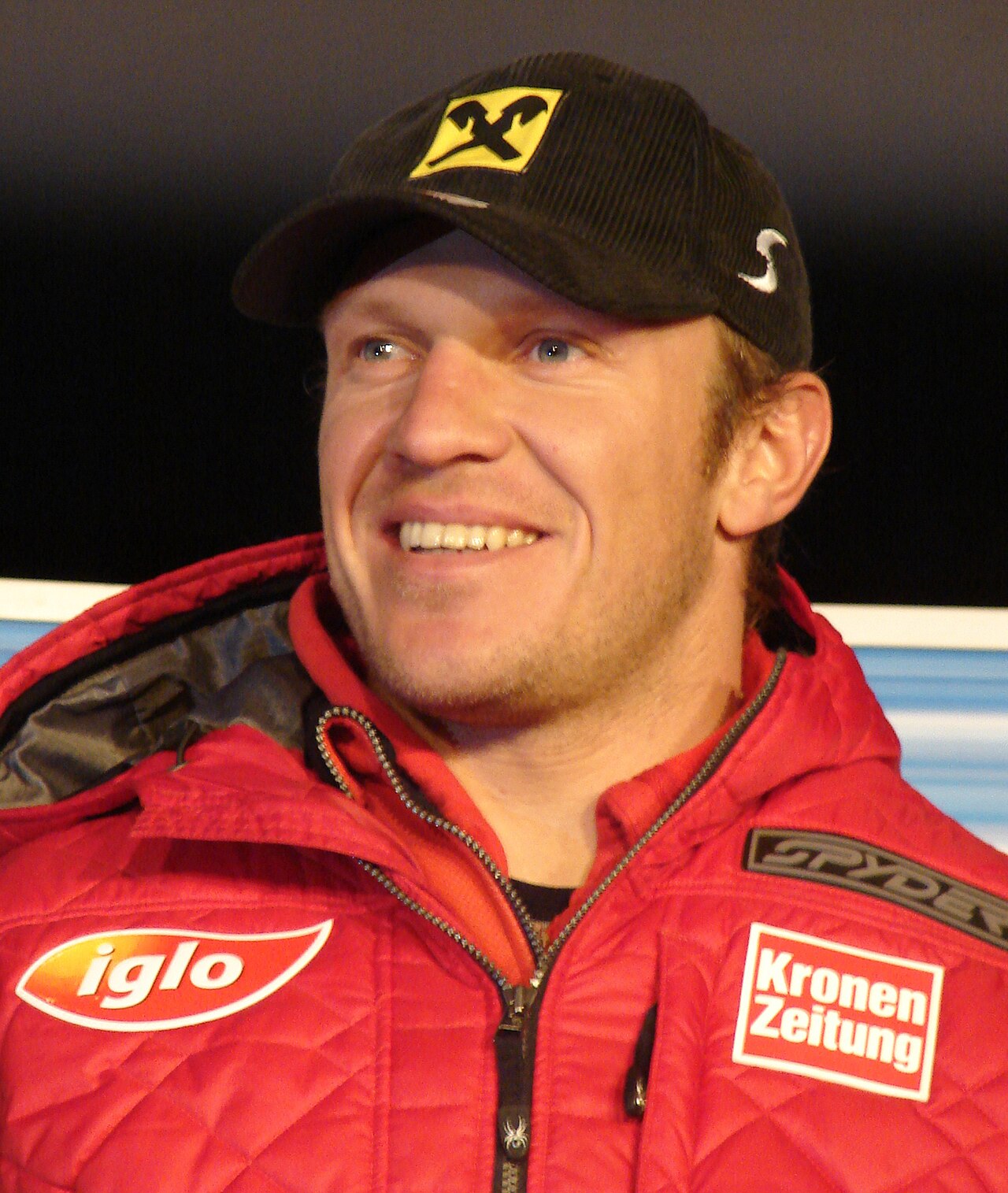
1972Hermann Maier(54 this year)Hermann Maier is an Austrian former World Cup champion alpine ski racer and Olympic gold medalist.
1984Robert Kubica(42 this year)Robert Józef Kubica is a Polish racing and rally driver who competes in the FIA World Endurance Championship for AF Corse.
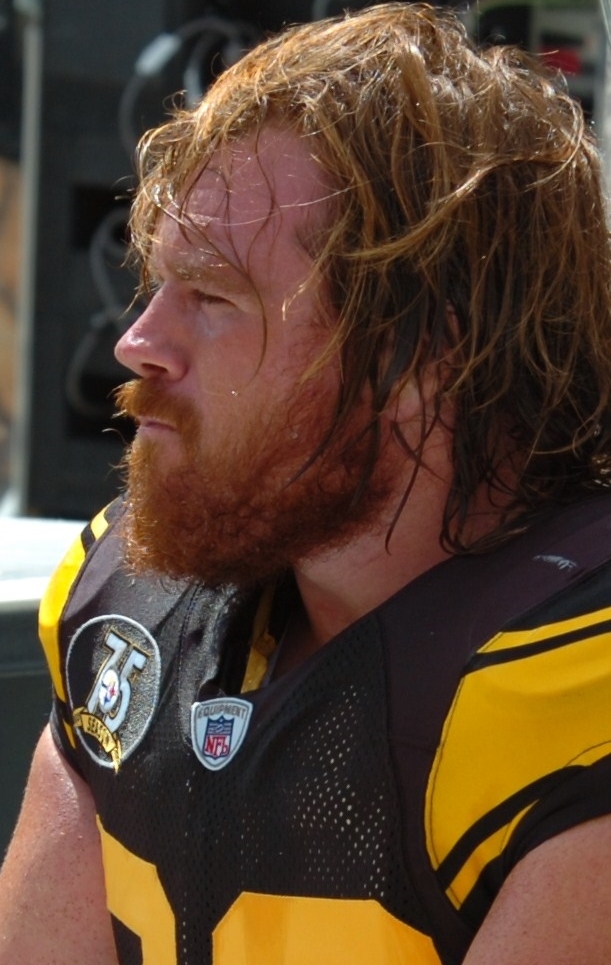
1976Alan Faneca(50 this year)Alan Joseph Faneca is an American former professional football player who was a guard in the National Football League (NFL) for 13 seasons.
521ColumbaColumba or Colmcille was an Irish abbot and missionary credited with spreading Christianity at the start of the Hiberno-Scottish mission in what became Scotland.
1861Henri Mathias BerthelotHenri Mathias Berthelot was a French general during World War I. He held an important staff position under Joseph Joffre, the French commander-in-chief, at the First Battle of the Marne, before later commanding a corps in the front line.
1863Pietro MascagniPietro Mascagni was an Italian composer primarily known for his operas.
1888Hamilton Fish IIIHamilton Fish III was an American soldier, author, politician and prominent isolationist from New York.
1900Kateryna Vasylivna BilokurKateryna Vasylivna Bilokur was a Ukrainian folk artist, painter and poet born in the Poltava Governorate.
1902Hilda TabaHilda Taba was an architect, a curriculum theorist, a curriculum reformer, and a teacher educator.
1910Louis PrimaLouis Leo Prima was an American trumpeter, singer, entertainer, and bandleader.
1915Leigh BrackettLeigh Douglass Brackett was an American author and screenwriter.
1920Walter NowotnyWalter Nowotny was an Austrian-born fighter ace of the Luftwaffe in World War II.
1921Pramukh Swami MaharajPramukh Swami Maharaj was the guru and Pramukh, or president, of the Bochasanwasi Akshar Purushottam Swaminarayan Sanstha (BAPS), a major branch of the Swaminarayan Sampradaya, a Hindu denomination.
1924John LoveJohn Maxwell Lineham Love was a Rhodesian racing driver.
1932J. B. SumarlinJohannes Baptista Sumarlin was an Indonesian economist who served as Minister of Finance.
1936Martha Layne CollinsMartha Layne Collins was an American businesswoman and politician from Kentucky; she served as the state's 56th governor from 1983 to 1987, the first woman to hold the office and the only one to date.
1942Alex JohnsonAlex Johnson was an American professional baseball outfielder, who played in Major League Baseball (MLB), from 1964 to 1976, for the Philadelphia Phillies, St. Louis Cardinals, Cincinnati Reds, California Angels, Cleveland Indians, Texas Rangers, New York Yankees, and Detroit Tigers.
1962Imad MughniyahImad Fayez Mughniyeh, also known by his nom de guerre al-Hajj Radwan, was a Lebanese militant leader who was the founding member of Lebanon's Islamic Jihad Organization and number two in Hezbollah's leadership.
1964Peter Laviolette(62 this year)Peter Philip Laviolette Jr. is an American professional ice hockey coach and former player who is the head coach for the Los Angeles Kings of the National Hockey League (NHL).
1966Shinichi Ito(60 this year)Shinichi Ito born December 7, 1966, in Kakuda, Miyagi, Japan) is a Japanese retired professional Grand Prix motorcycle road racer.
1966Kazue Itoh(60 this year)Kazue Itō is a Japanese actress from Seya-ku, Yokohama, Kanagawa Prefecture.
1967Tino Martinez(59 this year)Constantino "Tino" Martinez is an American former professional baseball player.
1973Damien Rice(53 this year)Damien George Rice is an Irish singer-songwriter.
1973Fabien Pelous(53 this year)Fabien Pelous is a retired French rugby union player.
Quote of the Day
“To be great is to be misunderstood.” — Ralph Waldo Emerson, Self-Reliance
December 7 History Quiz
Which spacecraft entered Jupiter's orbit on December 7, 1995?
Galileo
What was the name of the British commando raid on German ships in Bordeaux in December 1942?
Operation Frankton
Which country began its military occupation of East Timor on December 7, 1975?
Every event on this page was picked by hand from the historical record, written up as a news report, and checked against its source. Photographs are matched to the event they illustrate and verified before they are used. Sources are linked on each story.


 “Mack The Knife”,
  Advise and Consent, Allen Drury
 “Dominique”,
  The Group, Mary McCarthy
 “Kung Fu Fighting”,
  The Mammoth Hunters, Jean M. Auel
 “Black Or White”,
 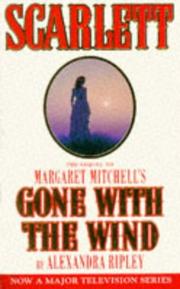 Scarlett, Alexandra Ripley
 “Lose Yourself”,
 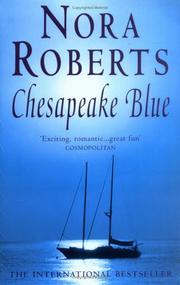 Chesapeake Blue, Nora Roberts
 Sycamore Row, John Grisham
 To Die For, David Baldacci