Our front page for July 12 — written and set by The Yesterday Times from the events below. Not an archival document.
Day of the year
193
Days left in 2026
172
In 2026 it falls on a
Sunday
Star sign
Cancer
Birthstone
Ruby
On July 12 in 1998, 28 years ago, France Wins World Cup, Beats Brazil 3-0. This page reports 8 stories from the date, 25 people born on this day.
The stories in full
World Cup Finals
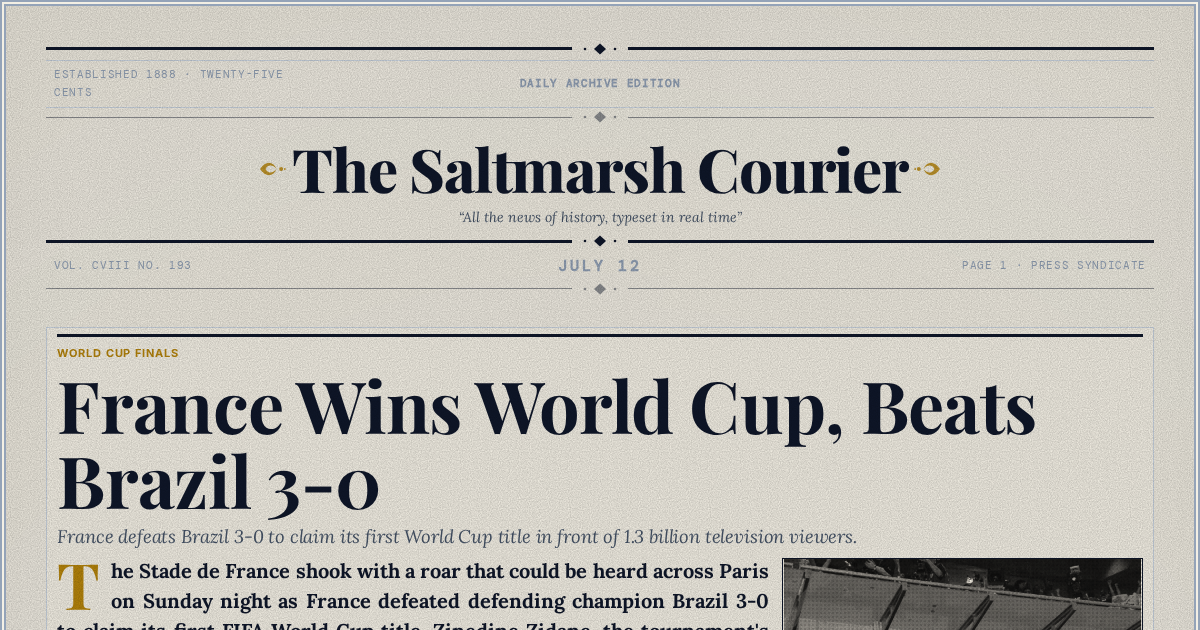
1998 — France Wins World Cup, Beats Brazil 3-0
France defeats Brazil 3-0 to claim its first World Cup title in front of 1.3 billion television viewers.
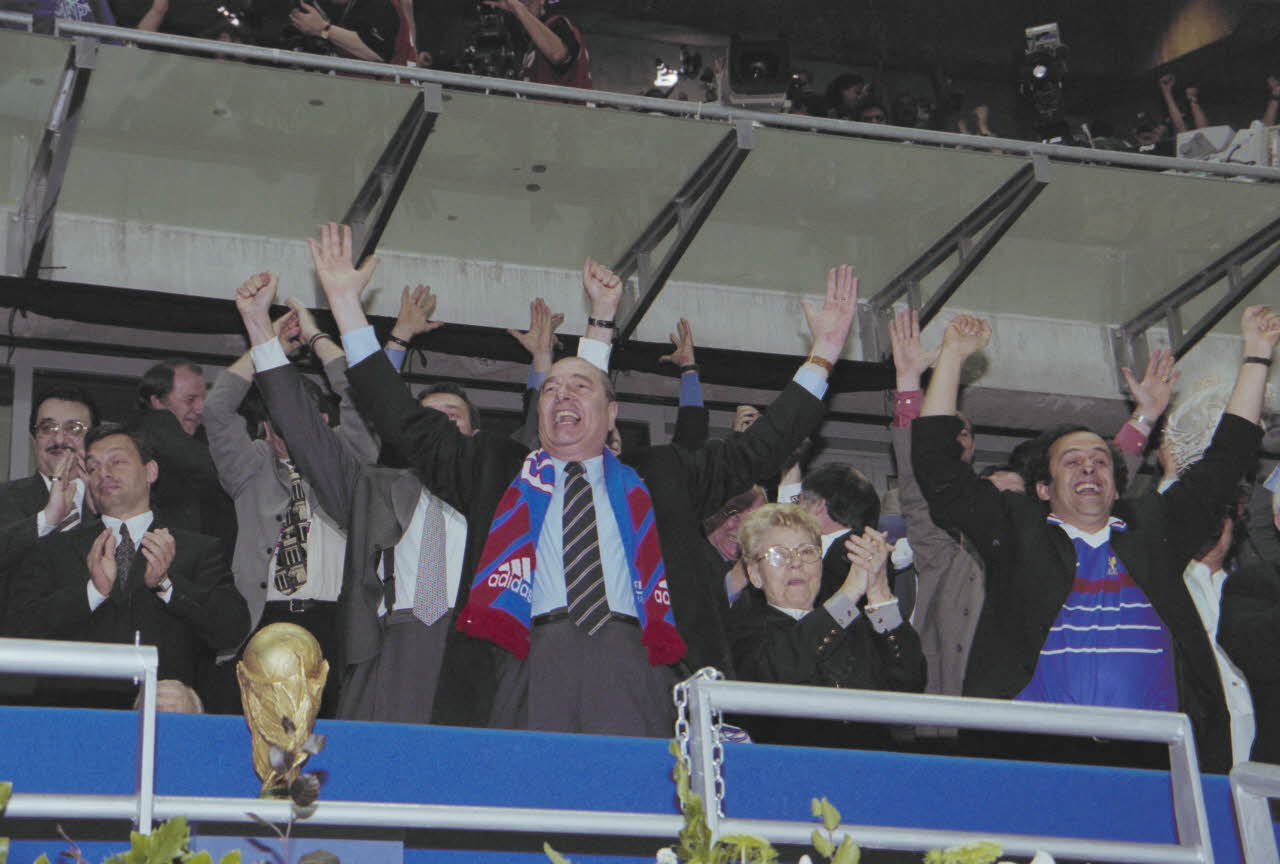
President Jacques Chirac celebrates France's historic 1998 World Cup victory over Brazil in Paris — Archives nationales
The Stade de France shook with a roar that could be heard across Paris on Sunday night as France defeated defending champion Brazil 3-0 to claim its first FIFA World Cup title. Zinedine Zidane, the tournament's quiet genius, scored two first-half headers from corners, and Emmanuel Petit added a third goal in second-half injury time. President Jacques Chirac, seated in the tribune, was among the delirious fans celebrating the historic victory.
France becomes the seventh different nation to win the World Cup, joining Uruguay, Italy, Germany, Brazil, England, and Argentina. The triumph was all the sweeter for coming against Brazil, the four-time champions, who were favorites to repeat.
The match, refereed by Said Belqola of Morocco, was watched by an estimated 1.3 billion people on television worldwide. In Paris, hundreds of thousands of supporters poured into the streets, waving tricolors and singing through the night. By Monday morning, the Champs-Élysées was a sea of humanity, with fans assembling to continue the celebration.
For France, the victory caps a remarkable run on home soil, a campaign that began with doubts and ended with the nation's first world title. The players, led by captain Didier Deschamps, were carried by the emotion of the crowd. Zidane, the son of Algerian immigrants, has become a national hero.
The final was played at the Stade de France in Paris on 12 July 1998 in front of 80,000 supporters.
Zinedine Zidane scored two first-half headers from corners, and Emmanuel Petit added a third goal in second-half injury time.
France's win was their first World Cup title, making them the seventh different nation to win the tournament.
An estimated 1.3 billion people watched the match on television worldwide.
Hundreds of thousands of French supporters celebrated in Paris throughout the night and assembled along the Champs-Élysées the next day.
Moscow Chronicle
1561 — St. Basil's Consecrated in Red Square
Built from 1555 to 1561 on Ivan the Terrible's orders, the nine-domed cathedral was consecrated in Red Square, with a tenth chapel added in 1588.
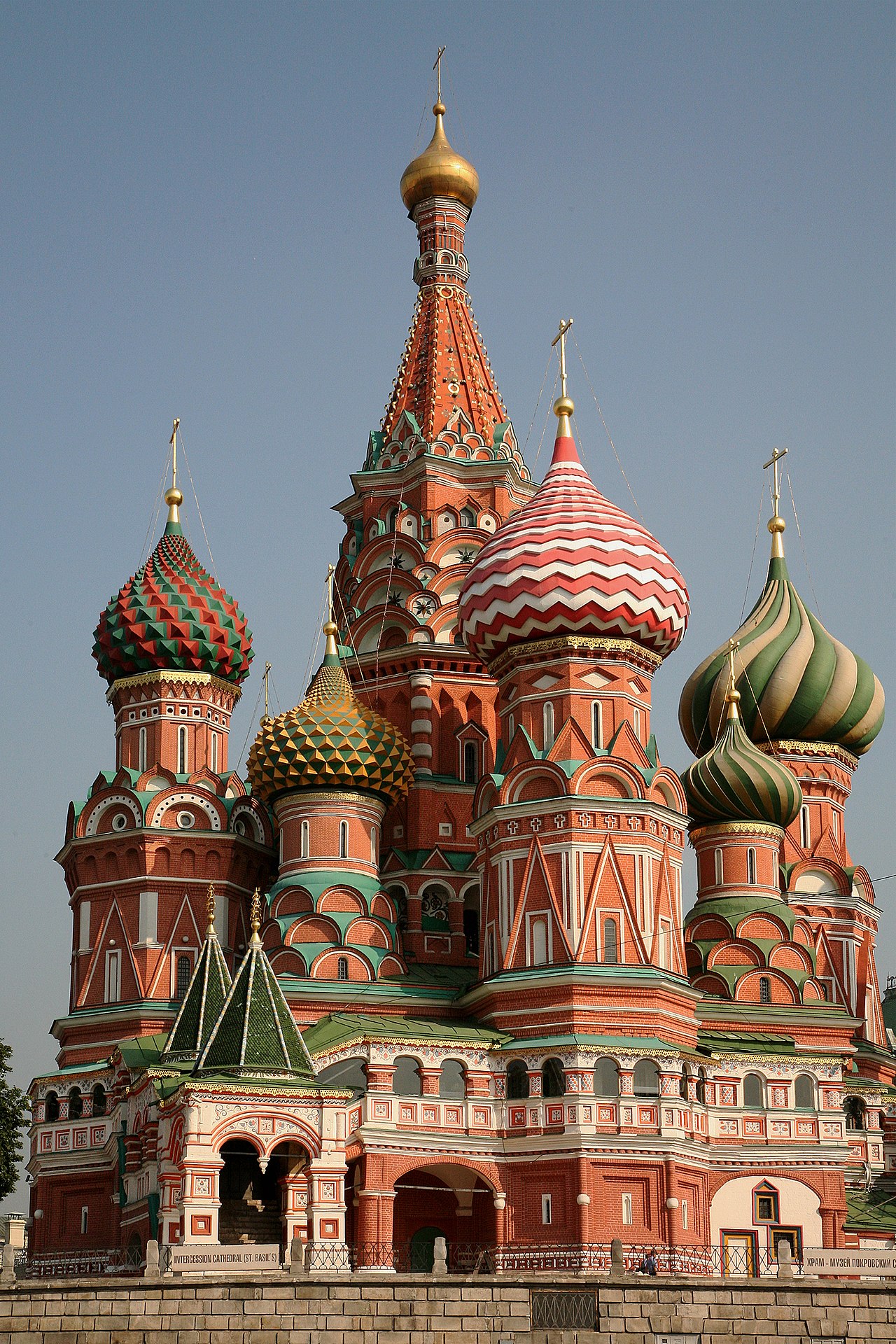
Saint Basil's Cathedral, the iconic Moscow landmark consecrated in the sixteenth century — W. Bulach
Saint Basil's Cathedral, built from 1555 to 1561 on orders from Ivan the Terrible, was consecrated in Moscow's Red Square. Its nine onion domes each crown a separate church, commemorating the capture of Kazan and Astrakhan. The original structure held eight chapels arrayed around a ninth dedicated to the Intercession, a design without precedent. A tenth chapel was added in 1588 to shelter the relics of Vasily, a holy fool venerated by the faithful. The cathedral's colours were completed in 1683, but its presence was already a triumph. Muscovites flock to the square to behold an edifice that rivals the Kremlin in wonder. It stands as a testament to piety and might, a visible sign of favor on the tsar's arms. Yet its beauty, say the chroniclers, is a gift to the city itself, a jewel among the wooden streets. The builders worked without a single master plan, chroniclers note, raising each chapel as the campaign against Kazan advanced. Muscovites say the domes shine brightest at dawn, when the light catches their gilded iron.
Saint Basil's Cathedral was built from 1555 to 1561 on orders from Ivan the Terrible.
The cathedral commemorates the capture of Kazan and Astrakhan.
The cathedral has nine distinctive onion domes, each corresponding to a different church.
The original building contained eight chapels arranged around a ninth central chapel dedicated to the Intercession.
A tenth chapel was erected in 1588 over the grave of the venerated local saint Vasily.
Eastern Front Dispatch
1943 — Soviet and German Armies Clash in Huge Tank Battle at Prokhorovka
The largest armour engagement of the war unfolds as the Red Army hurls counter-offensives against the German salient at Kursk.
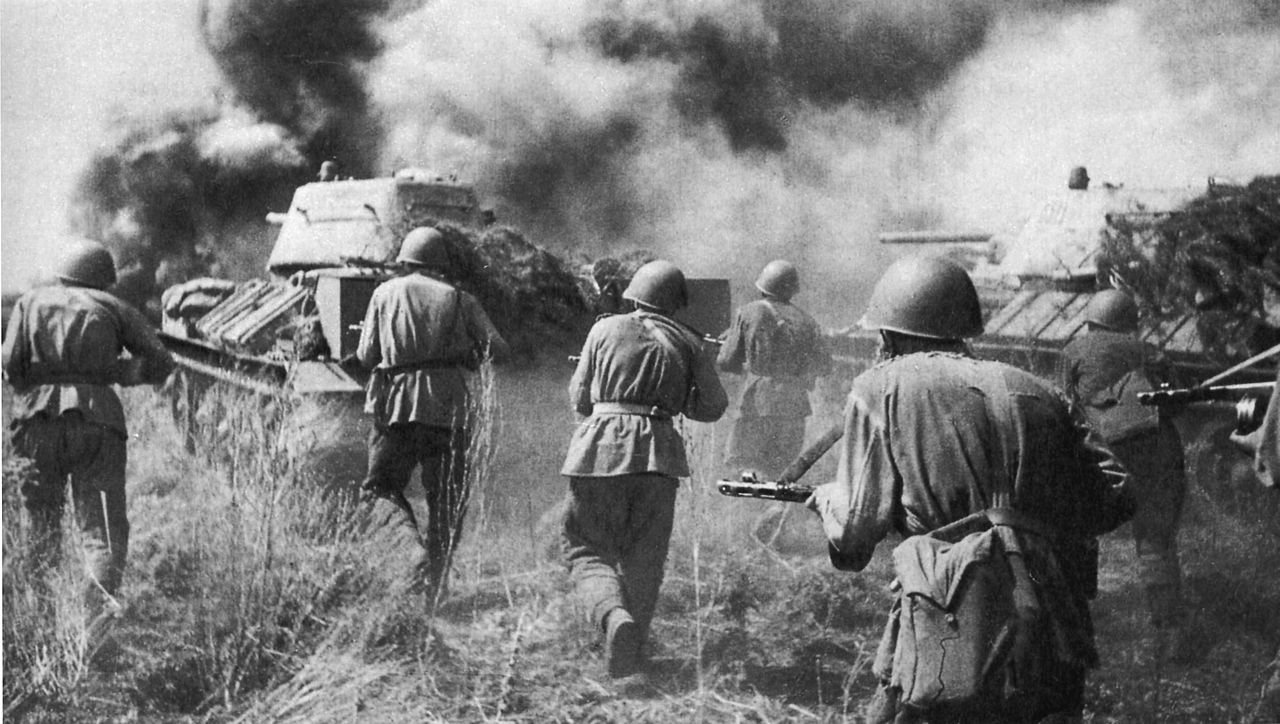
Soviet infantry and tanks advance during the decisive Battle of Prokhorovka in 1943 — Red Army photographer?
In the summer of 1943, the fate of the Eastern Front hangs on a bitter struggle around Kursk, where German and Soviet forces have engaged in one of the largest tank battles in military history. On 12 July, the Red Army launched its own counter-offensives against the German spearheads, meeting steel with steel in the fields near Prokhorovka. The clangour of T-34s and Tigers echoes across the steppe, as both sides commit armour in numbers never before seen.
The German offensive, begun weeks ago, has stalled against deep Soviet defences; now the initiative is slipping away. Soviet infantry and tanks, photographed advancing under smoke, press forward against the panzer divisions. The outcome, say observers, will decide whether the Wehrmacht can retain any hope of victory in the east, or whether the Red Army will begin its long march westward.
Casualties are heavy on both sides, but the Soviet counter-attack signals a turning point.
On 12 July 1943, the Soviets launched their own counter-offensives against German forces at the Kursk Bulge.
Film Desk
1997 — Miyazaki's 'Princess Mononoke' Opens, Sets Japan Box-Office Record
Hayao Miyazaki's animated epic becomes the highest-grossing film in Japan's history.
Hayao Miyazaki's animated epic Princess Mononoke opened in Japan today, immediately becoming the highest-grossing film in the country's history, a record it will hold for months. The ¥2.35 billion production ranks as Japan's most expensive animated film to date.
Princess Mononoke was released in Japan on July 12, 1997.
The film had a budget of ¥2.35 billion, making it the most expensive animated film in Japan at the time.
It was the first animated film to win the Japan Academy Film Prize for Picture of the Year.
The film was the first of Studio Ghibli's films to be released internationally, distributed by Miramax Films.
Neil Gaiman wrote the English translation, making significant alterations for the American audience.
Rockets and anti-tank fire across the border spark a five-week war.
Three Israeli soldiers were killed and two seized when Hezbollah militants crossed the border today, firing rockets at border towns as a diversion for an anti-tank missile attack on two armored Humvees. The assault, which also wounded two soldiers, opened a 34-day conflict.
On 12 July 2006, Hezbollah militants fired rockets at Israeli border towns as a diversion for an anti-tank missile attack on two armoured Humvees.
The attack killed three Israeli soldiers, injured two, and seized two Israeli soldiers.
The conflict lasted 34 days, from 12 July to 14 August 2006.
Hezbollah launched thousands of Katyusha rocket attacks against Israeli civilian towns and cities in northern Israel.
The war is believed to have killed 1,191–1,300 Lebanese citizens including combatants and 165 Israelis including soldiers.
War Desk
1948 — Rabin Signs Order Expelling Arabs From Lydda and Ramle
Tens of thousands forced out in war's largest expulsion.
Officer Yitzhak Rabin of the Israel Defense Forces signed an order today expelling Palestinians from Lydda and Ramle, declaring: "The inhabitants of Lydda must be expelled quickly without attention to age." Ramle's residents were bussed out, but Lydda's people walked miles in summer heat to Arab lines.
The expulsion order signed by Yitzhak Rabin stated: 'The inhabitants of Lydda must be expelled quickly without attention to age.'
Ramle's residents were bussed out, while the people of Lydda were forced to walk miles during a summer heat wave to the Arab front lines.
An estimated 50,000 to 70,000 Palestinians were expelled from Lydda and Ramle in July 1948.
A number of refugees died from exhaustion and dehydration during the exodus, with estimates ranging from a handful to 500.
The expulsion was the biggest of the war and occurred after fighting resumed following a truce period.
Music Hall
1962 — Rollin' Stones Debut at Marquee Club
Six-piece band plays first London show at small West End venue.
In a small, cheap venue in London's West End, a new band called the Rollin' Stones took the stage tonight at the Marquee Club. The club, opened in 1958, hosted the group's first live performance. The lineup was Mick Jagger, Brian Jones, Keith Richards, Ian Stewart, Dick Taylor, and an unconfirmed drummer. They played a set of rhythm and blues to a modest crowd. The Marquee, known for jazz and blues, now adds this young sextet to its roster. The band's sound drew from American blues, a staple of the club's bookings. The crowd, a mix of jazz regulars and curious passersby, drifted in and out during the set. Few could have guessed the night’s place in the club’s growing story.
The band played their first show billed as 'the Rollin' Stones' on 12 July 1962, at the Marquee Club in London.
At the time, the band consisted of Mick Jagger, Brian Jones, Keith Richards, Ian Stewart, Dick Taylor, and an unconfirmed drummer.
The Marquee Club was a small and relatively cheap venue in London's West End, opened in 1958.
The Marquee Club was the location of the first live performance by the Rolling Stones on 12 July 1962.
City Desk
1979 — Disco Demolition Night Ends in Riot, Forfeit at Comiskey
Explosion tears hole in field, 20,000 crash gates, second game forfeited.
The promotional stunt turned a baseball doubleheader into a riot, as more than 50,000 fans, plus 20,000 who crashed the gates, stormed the field at Comiskey Park. The explosion tore a hole in center field, and thousands of fans stole equipment. The second game was forfeited, the fourth in American League history this decade.
Radio personality Steve Dahl and White Sox promotions manager Mike Veeck organized Disco Demolition Night on July 12, 1979.
Fans paid 98¢ for tickets in exchange for bringing disco records, which were destroyed between games of a doubleheader.
More than 50,000 fans attended, and an additional 20,000 crashed the gates, overwhelming stadium security.
The explosion tore a huge hole in center field, and thousands of intoxicated fans stormed the field, stealing equipment.
The second game was postponed and later ruled a forfeit, the fourth in American League history in the 1970s.
What the papers printed that morning
Real front pages from 12 July 1943, scanned by the Library of Congress. These are archival documents, not our work.
100 BCJulius CaesarGaius Julius Caesar was a Roman general, statesman, and author who was the dictator of the Roman Republic almost continuously from 49 BC until his assassination in 44 BC.
1997Malala Yousafzai(29 this year)Malala Yousafzai is a Pakistani female education activist, and producer of film and television.
1884Amedeo ModiglianiAmedeo Clemente Modigliani was an Italian painter and sculptor of the École de Paris who worked mainly in France.
1849William OslerSir William Osler, 1st Baronet was a Canadian physician and one of the "Big Four" founding professors of Johns Hopkins Hospital.
1962Julio César Chávez(64 this year)Julio César Chávez González, also known as Julio César Chávez Sr., is a Mexican former professional boxer who competed from 1980 to 2005.
2001Kaylee McKeown(25 this year)Kaylee Rochelle McKeown is an Australian swimmer and multiple Olympic gold medalist.
1988LeSean McCoy(38 this year)LeSean Kamel McCoy, nicknamed "Shady", is an American former professional football player who was a running back in the National Football League (NFL).
1881Natalia GoncharovaNatalia Sergeevna Goncharova was a Russian avant-garde artist, painter, costume designer, writer, illustrator, and set designer.
1884Bob DiryRobert "Bob" Diry was an Austrian middleweight world champion 1908 in wrestling.
1917Luigi GorriniLuigi Gorrini, MOVM, was an Italian World War II fighter pilot in the Regia Aeronautica and in the Aeronautica Nazionale Repubblicana.
1917Satyendra Narayan SinhaSatyendra Narayan Sinha was an Indian politician and statesman, participant in the Indian independence movement, a leading light of Jaya Prakash Narayan's ‘complete revolution’ movement during the Emergency and a former Chief Minister of Bihar.
1920Bob FillionJoseph Louis Robert Edgar Fillion was a Canadian professional ice hockey player who played seven seasons for the Montreal Canadiens of the National Hockey League (NHL) between 1943 and 1950.
1920Pierre BertonPierre Francis de Marigny Berton was a Canadian historian, writer, journalist and broadcaster.
1922Mark HatfieldMark Odom Hatfield was an American politician and educator from the state of Oregon.
1923James E. GunnJames Edwin Gunn was an American science fiction writer, editor, scholar, and anthologist.
1927Harley HotchkissHarley Norman Hotchkiss was a Canadian business and community leader who was best known for his contributions to health and sports development in Canada.
1928Imero FiorentinoImero (Immie) Fiorentino was an American lighting designer, considered one of the most respected pioneers and leaders in the American entertainment industry.
1935Satoshi Ōmura(91 this year)Satoshi Ōmura is a Japanese biochemist.
1937Lionel JospinLionel Robert Jospin was a French politician who served as Prime Minister of France from 1997 to 2002.
1937Bill Cosby(89 this year)William Henry Cosby Jr. is an American former comedian, actor, and media personality.
1938Ray Scott(88 this year)John Raymond Scott is an American former professional basketball player and coach.
1952Voja Antonić(74 this year)Vojislav "Voja" Antonić is a Serbian inventor, journalist, and writer.
1952Irina Bokova(74 this year)Irina Georgieva Bokova is a Bulgarian politician and a former Director-General of UNESCO (2009–2017).
1957Dave SemenkoDavid John Semenko was a Canadian professional ice hockey player, coach, scout, and colour commentator.
1970Lee Byung-hun(56 this year)Lee Byung-hun is a South Korean actor.
Quote of the Day
“Some are born great, some achieve greatness, and some have greatness thrust upon them.” — William Shakespeare, Twelfth Night
July 12 History Quiz
Which French player scored twice in the 1998 World Cup final against Brazil?
Zinedine Zidane
What was the name of the Rolling Stones' original lead guitarist who left the band in 1963?
Dick Taylor
In the film 'Princess Mononoke', what is the name of the protagonist who is cursed by a boar god?
Every event on this page was picked by hand from the historical record, written up as a news report, and checked against its source. Photographs are matched to the event they illustrate and verified before they are used. Sources are linked on each story.


 The Love Machine, Jacqueline Susann
 The Moneychangers, Arthur Hailey
 The Bourne Identity, Robert Ludlum
 Plum Island, Nelson DeMille
 The Da Vinci Code, Dan Brown
 Top Secret Twenty-One, Janet Evanovich
 “Ordinary”,
  Atmosphere, Taylor Jenkins Reid


