Our front page for July 13 — written and set by The Yesterday Times from the events below. Not an archival document.
Day of the year
194
Days left in 2026
171
In 2026 it falls on a
Monday
Star sign
Cancer
Birthstone
Ruby
On July 13 in 1930, 96 years ago, World Cup Opens in Montevideo as 13 Nations Vie. This page reports 10 stories from the date, 25 people born on this day.
The stories in full
Sporting
1930 — World Cup Opens in Montevideo as 13 Nations Vie
Uruguay defeats Argentina 4–2 in the final before 68,346 spectators to become the first world champions.
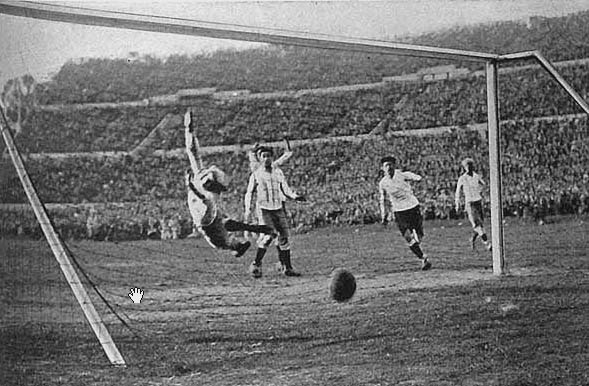
Action during the inaugural 1930 FIFA World Cup tournament held in Montevideo, Uruguay — Wikimedia Commons
The first world championship of football passed from dream to fact on Sunday, as Uruguay flung open the Estadio Centenario and thirteen nations began a fortnight of play that will crown a single champion. The tournament, running from July 13 to July 30, is the boldest stroke yet in the game's rise from parish pastime to international spectacle.
All matches are being played in Montevideo, most on the freshly raised Centenario pitch. Seven South American sides, four European and two North American answer the call. France's Lucien Laurent wrote the first line of World Cup history with the opening goal of the competition.
The European contingent — Belgium, France, Romania and Yugoslavia — made the long sea passage only after Jules Rimet, president of FIFA, pressed the case. The photograph accompanying this report shows the play in full swing before the local crowds, who have taken the tournament to heart.
Uruguay, the host, meets Argentina in the final before 68,346 spectators and wins 4–2, becoming the first world champions.
The first FIFA World Cup took place in Uruguay from July 13 to 30, 1930.
All matches were played in Montevideo, mostly at the purpose-built Estadio Centenario.
Thirteen teams entered the tournament, with seven from South America, four from Europe, and two from North America.
France's Lucien Laurent scored the first goal in World Cup history on July 13, 1930.
Uruguay defeated Argentina 4–2 in the final before 68,346 spectators to become the first World Cup champion.
World Football
2014 — Germany Win Fourth World Cup in Rio
A single goal in extra time, scored by Mario Götze, settled the Maracanã final against Argentina and gave Europe a first title on American soil.
A little more than a century after football's modern rules were written in England, the game's greatest prize crossed the Atlantic again on Sunday night, and this time it stayed with Europe. Germany beat Argentina 1–0 in the World Cup final at the Maracanã in Rio de Janeiro, with Mario Götze scoring the only goal in the 113th minute, volleying André Schürrle's cross past the Argentine goalkeeper.
The victory, watched by 74,738 in the stadium and more than a billion on television, gave Germany their fourth world title and made them the first European side to win the tournament in the Americas. Götze, a 22-year-old substitute, had been on the pitch barely half an hour when he settled a final that had been tense, tight and goalless through 90 minutes.
The final was played at the Maracanã Stadium in Rio de Janeiro, Brazil, on 13 July 2014.
Mario Götze scored the winning goal in the 113th minute, volleying a cross from André Schürrle to secure a 1–0 victory.
Germany's win was their fourth World Cup title and the first by a European team in the Americas.
The match was witnessed by 74,738 spectators in the stadium and over a billion television viewers.
Lionel Messi was awarded the Golden Ball as FIFA's outstanding player of the tournament.
Intelligence
2003 — French Spy Mission to Free Betancourt Aborted
The French foreign intelligence service aborted a secret mission to free Íngrid Betancourt, a failure that has become a political scandal in Paris.
The French foreign intelligence service aborted a secret mission to free Íngrid Betancourt from her FARC captors, a failure that has become a political scandal in Paris.
Opération 14 juillet was a failed DGSE mission to rescue Íngrid Betancourt from FARC rebels.
The DGSE was held responsible for the outcome of the failed rescue mission.
Operation Tigar concludes with a 17-kilometre advance into the hinterland, part of efforts to break the siege of Dubrovnik.
The Croatian Army has concluded Operation Tigar, a two-week drive that ended today. The operation advanced 17 kilometres into the Dubrovnik hinterland. It aimed to relieve the siege of Dubrovnik. This was part of smaller Croatian actions after the 1992 ceasefire.
Operation Tigar (Tiger) was conducted by the Croatian Army from July 1 to July 13, 1992, in the Dubrovnik hinterland.
The operation aimed to relieve the siege of Dubrovnik as part of several smaller Croatian actions after the 1992 ceasefire.
Whitehall
1962 — Macmillan Ousts Seven in Cabinet Sweep
Prime minister dismisses seven cabinet members in an unprecedented reshuffle.
Prime Minister Harold Macmillan dismissed seven members of his cabinet today in an unprecedented reshuffle that shook the government. The purge, announced from Downing Street, removed senior figures in a single stroke, leaving Westminster stunned. Macmillan acted to reshape his administration amid mounting pressure over economic troubles and slipping popularity. The dismissed ministers were not named immediately, but political observers noted the sweep was the largest since the war. The Prime Minister's office said replacements would be announced shortly, and speculation centered on younger men loyal to Macmillan. The shake-up signals a determined bid to revive the government's fortunes before the next election.
In an unprecedented reshuffle, British prime minister Harold Macmillan dismissed seven members of his cabinet.
Weather Desk
2013 — Typhoon Soulik Kills 20 in China, Taiwan
Typhoon Soulik kills 20 in Taiwan and East China.
Roofs tore off and trees snapped as Typhoon Soulik struck late July 12 in northern Taiwan, then again July 13 in Fujian, China. The storm killed at least 20 people. In Taiwan, four died and 123 were injured; 11 died in East China. Nearly 800,000 people lost electricity in Taiwan, and gusts hit 220 km/h. More than 162 million were affected in East China.
Typhoon Soulik made landfall late on July 12 in northern Taiwan and again on July 13 in Fujian, China.
It brought gusts up to 220 km/h and left roughly 800,000 people without electricity in Taiwan.
Four people died and 123 were injured in Taiwan; 11 people died in East China.
More than 162 million people in East China were affected by the storm.
In Okinawa, a peak gust of 217 km/h was measured, leaving 16,100 households without power and causing ¥573 million in crop damage.
Civil War Gazette
1643 — Royalists Rout Parliament at Roundway Down
Victory near Devizes opens the way for Prince Rupert to capture Bristol.
The Royalist triumph at Roundway Down has broken the Parliamentarian hold on the West, and Prince Rupert now stands ready to seize Bristol. On July 13, near Devizes in Wiltshire, the King's horse and foot overwhelmed the rebel army, scattering their ranks.
After the Battle of Roundway Down, Prince Rupert was able to capture Bristol.
City News
1863 — Draft Riots Erupt in New York City
Four days of violence begin against conscription laws passed by Congress.
In the fourth summer of the war, a new fury has seized New York, as mobs rise against the draft. On July 13, 1863, four days of rioting began in response to laws passed by Congress to conscript men for the Union armies. The mobs attacked draft offices, halted streetcars, and set fires across the city.
The New York City draft riots began on July 13, 1863.
Draft evasion involves avoiding a government-imposed obligation to serve in the military.
Riots against the draft are a form of draft resistance.
Los Angeles County
2020 — Actress Naya Rivera's Body Recovered From Lake Piru
Five-day search ends after the 33-year-old drowned saving her four-year-old son.
Naya Rivera, the actress and singer known for her role on "Glee," was found dead on July 13, 2020, five days after she drowned in Lake Piru near Santa Clarita, California. Authorities confirmed her body was recovered from the lake. Rivera, 33, died on July 8 while saving her four-year-old son during a boating trip. She was between seasons of the series "Step Up," playing Collette Jones. Born January 12, 1987, Rivera is survived by her son. The five-day search for the actress drew widespread attention from her former "Glee" castmates and fans. Ventura County sheriff's officials confirmed the identity of the body Monday afternoon.
Naya Rivera's body was recovered from Lake Piru on July 13, 2020, after a five-day search.
Rivera drowned on July 8, 2020, while saving her four-year-old son during a boating trip at Lake Piru near Santa Clarita, California.
She was 33 years old at the time of her death, born January 12, 1987.
At the time of her death, Rivera was between seasons of the television series Step Up, in which she played Collette Jones.
Washington Bureau
1973 — Ex-Aide Tells Senate of Secret Nixon Taping System
Butterfield reveals hidden microphones in Oval Office, known to few.
The first public disclosure of a secret White House taping system came July 13, 1973, when former deputy chief of staff Alexander Butterfield told Senate investigators that President Nixon recorded conversations in the Oval Office. Butterfield said he oversaw the installation of five hidden microphones in Nixon's desk, two in lamps, and two in the cabinet room. The system was known only to Nixon, H. R. Haldeman, aide Larry Higby, and three or four Secret Service technical staffers. Senate Watergate Committee staff had routinely asked witnesses about taping since John Dean's testimony.
Alexander Butterfield revealed the existence of the secret taping system on July 13, 1973, during the Watergate investigation.
Butterfield oversaw the installation of five hidden microphones in Nixon's desk in the Oval Office, two in lamps, and two in the cabinet room.
The taping system was known only to Nixon, Haldeman, Higby, and three or four Secret Service technical staffers who installed it.
Butterfield was deputy assistant to President Nixon from 1969 to 1973 and later became administrator of the Federal Aviation Administration.
Senate Watergate Committee staff routinely asked witnesses if they knew of any taping system after John Dean testified in June 1973.
What the papers printed that morning
Real front pages from 13 July 1930, scanned by the Library of Congress. These are archival documents, not our work.
1962Tom Kenny(64 this year)Thomas James Kenny is an American actor and comedian.
1841Otto WagnerOtto Koloman Wagner was an Austrian architect, furniture designer and urban planner.
1982Yadier Molina(44 this year)Yadier Benjamín Molina is a Puerto Rican professional baseball manager, adviser, and former catcher who is the manager of Navegantes del Magallanes of the Venezuelan Professional Baseball League (LVBP) and a special assistant to the president of baseball operations for the St. Louis Cardinals of Major League Baseball (MLB).
1984Faf du Plessis(42 this year)François "Faf" du Plessis is a South African cricketer and former captain of the South Africa national cricket team.
1989Leon Bridges(37 this year)Todd Michael "Leon" Bridges is an American singer, songwriter, record producer, and actor.
1756Thomas RowlandsonThomas Rowlandson was an English artist and caricaturist of the Georgian Era, noted for his political satire and social observation.
1933Piero ManzoniPiero Manzoni di Chiosca e Poggiolo was an Italian artist best known for his ironic approach to avant-garde art.
1745Robert CalderAdmiral of the White Sir Robert Calder, 1st Baronet, was a Royal Navy officer who served in the Seven Years' War, the American Revolutionary War, the French Revolutionary Wars and the Napoleonic Wars.
1858Stewart CulinRobert Stewart Culin was an American ethnographer and author interested in games, art and dress.
1859Sidney WebbSidney James Webb, 1st Baron Passfield was a British socialist, economist and reformer, who co-founded the London School of Economics.
1864John Jacob Astor IVJohn Jacob Astor IV was an American business magnate, real estate developer, and investor who was a member of the Astor family and also the Livingston family.
1889Stan CoveleskiStanley Anthony Coveleski was an American right-handed pitcher in Major League Baseball who played for four American League (AL) teams between 1912 and 1928, primarily the Cleveland Indians.
1892Jonni MyyräJoonas "Jonni" Myyrä was a Finnish athlete who competed at the 1912, 1920 and 1924 Olympics.
1908Dorothy RoundDorothy Edith Round was a British tennis player who was active from the late 1920s until 1950.
1913Dave GarrowayDavid Cunningham Garroway was an American radio and television host on NBC.
1918Marcia BrownMarcia Joan Brown was an American writer and illustrator of more than 30 children's books.
1919William F. QuinnWilliam Francis Quinn OESSH was an American lawyer and politician.
1930Naomi ShemerNaomi Shemer was an Israeli songwriter, composer, and performer, widely described as the "first lady of Israeli song".
1932Per NørgårdPer Nørgård was a Danish composer and music theorist.
1934Peter GzowskiPeter John Gzowski, known colloquially as "Mr. Canada", or "Captain Canada", was a Canadian broadcaster, writer and reporter, most famous for his work on the CBC radio shows This Country in the Morning and Morningside.
1935Kurt WestergaardKurt Westergaard was a Danish cartoonist.
1935Jack KempJack French Kemp was an American politician, professional football player, and U.S. Army veteran who served as the ninth secretary of housing and urban development under President George H. W. Bush from 1989 to 1993.
1948Tony Kornheiser(78 this year)Anthony Irwin Kornheiser is an American television sports talk show host, podcaster, and former sportswriter and columnist.
1953David Thompson(73 this year)David O'Neil Thompson, commonly known by the nickname "Skywalker", is an American former professional basketball player.
1959Fuziah Salleh(67 this year)Fuziah binti Salleh is a Malaysian politician who has served as the Deputy Minister of Domestic Trade and Costs of Living in the Unity Government administration under Prime Minister Anwar Ibrahim and Ministers Salahuddin Ayub and Armizan Mohd Ali as well as Senator since December 2022.
Quote of the Day
“To be, or not to be, that is the question.” — William Shakespeare, Hamlet
July 13 History Quiz
Who scored the only goal in the 2014 FIFA World Cup final between Germany and Argentina?
Mario Götze
Which country hosted the first FIFA World Cup in 1930?
Uruguay
What did Alexander Butterfield reveal to the Senate Watergate Committee on July 13, 1973?
The existence of a secret taping system in the Oval Office
What triggered the New York City draft riots of 1863?
The Conscription Act
In what body of water was Naya Rivera's body recovered?
Lake Piru
What was the name of the typhoon that killed at least 20 people in China and Taiwan on July 13, 2013?
Typhoon Soulik
Who won the Battle of Roundway Down on July 13, 1643?
Royalists
Which British prime minister dismissed seven cabinet members on July 13, 1962 (the 'Night of the Long Knives')?
Every event on this page was picked by hand from the historical record, written up as a news report, and checked against its source. Photographs are matched to the event they illustrate and verified before they are used. Sources are linked on each story.




 “Lonely Boy”,
  Exodus, Leon Uris
 The Shoes of the Fisherman, Morris West
 “Rock Your Baby”,
  Watership Down, Richard Adams
 “A View To A Kill”,
  Skeleton Crew, Stephen King
 “Rush Rush”,
  The Kitchen God's Wife, Amy Tan
 “Hot In Herre”,
  Hard Eight, Janet Evanovich
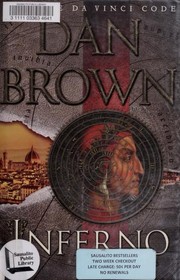 Inferno, Dan Brown
 “A Bar Song (Tipsy)”,
  Red Sky Mourning, Jack Carr