Our front page for July 7 — written and set by The Yesterday Times from the events below. Not an archival document.
Day of the year
188
Days left in 2026
177
In 2026 it falls on a
Tuesday
Star sign
Cancer
Birthstone
Ruby
On July 7 in 1974, 52 years ago, West Germany Wins World Cup. This page reports 9 stories from the date, 25 people born on this day.
The stories in full
Sports
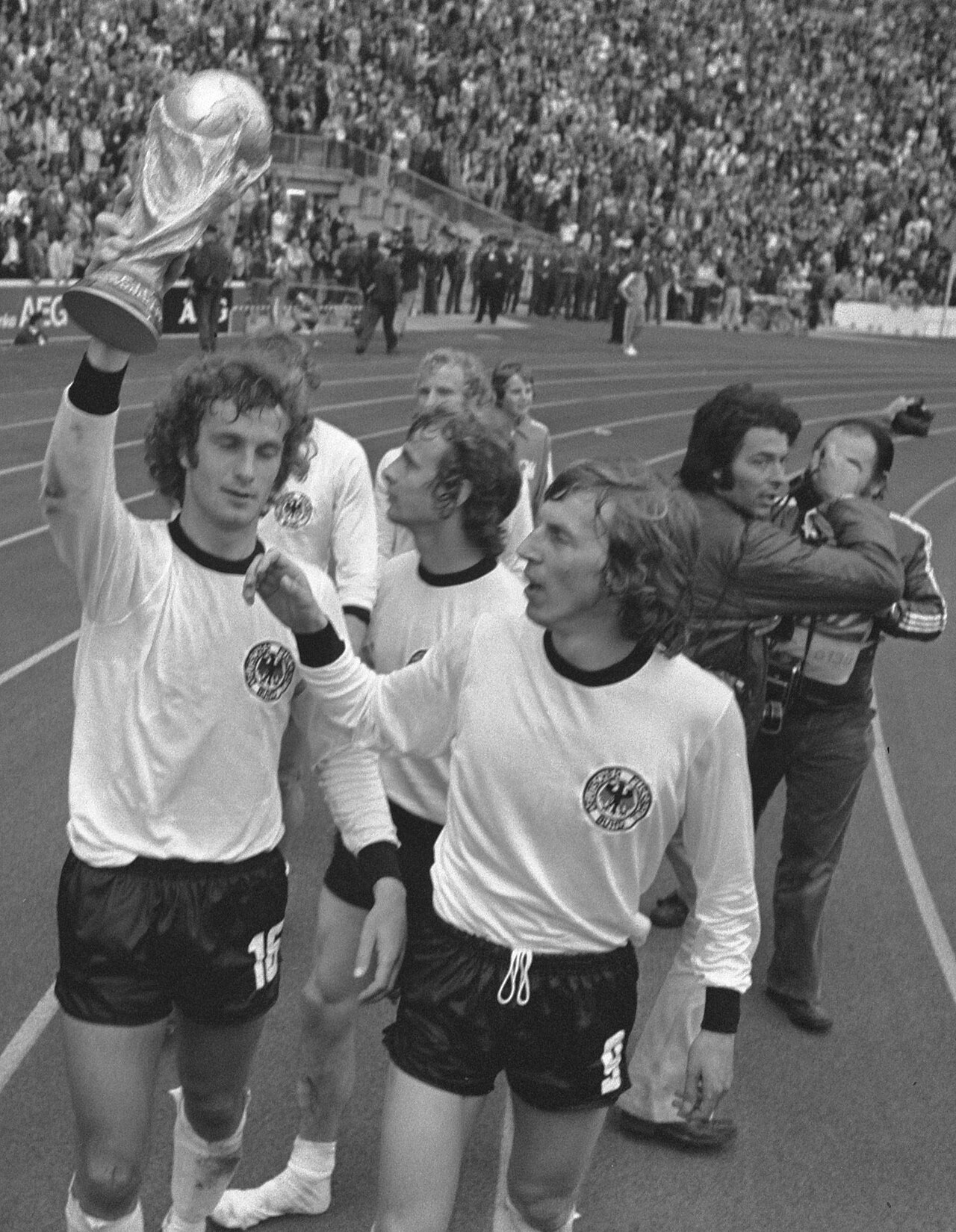
1974 — West Germany Wins World Cup
West Germany conquer the Netherlands 2–1 in Munich — Müller breaks scoring record; penalties make final history.
West Germany celebrates winning the 1974 FIFA World Cup final at Munich's Olympiastadion — Bert Verhoeff / Anefo
West Germany is world champion for the second time, defeating the Netherlands 2–1 in the World Cup final before a packed Olympiastadion in Munich. The victory crowns a tournament that had seen the host nation struggle early, yet the team rallied to claim football's supreme prize.
The Dutch struck first through a Johan Neeskens penalty in the second minute, but Paul Breitner equalised from the spot in the 25th. Gerd Müller then delivered the winner in the 43rd minute, his 14th World Cup goal, surpassing Just Fontaine's record of 13.
The two penalties were the first ever awarded in a World Cup final. Five German players became the first to have won gold, silver and bronze at the World Cup.
West Germany beat the Netherlands 2–1 in the final at the Olympiastadion in Munich.
The Netherlands opened the scoring via a Johan Neeskens penalty in the second minute, before Paul Breitner equalised with another penalty in the 25th minute.
Gerd Müller scored the winning goal in the 43rd minute, his 14th World Cup goal, beating Just Fontaine's record of 13.
Five German players became the first to have won gold, silver and bronze medals at the FIFA World Cup.
The two penalties in the final were the first to be awarded in a World Cup Final.
World Desk
1983 — Samantha Smith Meets Andropov
American girl, 10, arrives as Soviet leader's guest
A 10-year-old American girl has become an unlikely bridge between the superpowers. Samantha Smith of Manchester, Maine, arrived in the Soviet Union as the personal guest of Soviet leader Yuri Andropov. He invited her after she wrote to him in November 1982 asking if he would start a war. Andropov replied in April, inviting her to visit that summer, including a stay at the international children's camp Artek. Her letter, published in Pravda, made her a goodwill ambassador, known as America's Youngest Ambassador.
Samantha Smith, age 10, wrote to Soviet leader Yuri Andropov in November 1982 asking if he would start a war.
Andropov replied on April 26, 1983, inviting Smith to visit the Soviet Union that summer.
Smith's letter was published in the Soviet state-run newspaper Pravda.
Andropov's invitation included a visit to the international children's camp Artek on the sea.
Smith attracted extensive media attention as a 'Goodwill Ambassador,' becoming known as America's Youngest Ambassador.
Foreign Desk
1963 — Saigon Police Beat U.S. Journalist; Camera Broken
Arnett punched, camera smashed; protest filed over 'open physical intimidation.'
The secret police of Ngo Dinh Nhu, brother and chief adviser to President Diem, attacked American journalists covering a Buddhist protest in Saigon today. Associated Press reporter Peter Arnett was punched in the nose and his camera smashed.
On 7 July 1963, Nhu's secret police punched Associated Press reporter Peter Arnett in the nose and broke his camera.
Malcolm Browne photographed Arnett's bloodied face; the film survived despite police smashing his camera.
The attack occurred after journalists tried to photograph Buddhist protesters blocked by police near a Saigon pagoda.
The incident, known as the Double Seven Day scuffle, embarrassed the Diem regime when Arnett's bloodied photo was published in US newspapers.
The Saigon press corps formally protested Nhu's 'open physical intimidation' to prevent coverage of news Americans had a right to know.
Religion
1456 — Joan of Arc Declared Innocent of Heresy in Retrial
Twenty-five years after her death, church nullifies original verdict, citing improper procedures, deceit, and fraud.
Twenty-five years after her death, Joan of Arc has been declared innocent of heresy. On July 7, 1456, the church ruled that her original trial was invalid due to improper procedures, deceit, and fraud, clearing the name of the Maid of Orleans.
The retrial came after Joan's mother Isabelle Romée and her brothers Jean and Pierre petitioned Pope Callixtus III to reopen the case. Inquisitor-General Jean Bréhal investigated, and the appeal opened at Notre-Dame Cathedral on November 7, 1455, with Romée delivering an impassioned speech.
The original trial of Joan of Arc was judged invalid due to improper procedures, deceit, and fraud on July 7, 1456.
Joan's mother Isabelle Romée and brothers Jean and Pierre petitioned Pope Callixtus III to reopen the case.
Inquisitor-General Jean Bréhal investigated the appeal at the request of Joan's surviving family.
The retrial opened at Notre-Dame Cathedral on November 7, 1455, with Isabelle Romée delivering an impassioned speech.
Pope Callixtus III appointed three French higher clergy to review the case with Inquisitor Bréhal.
Washington
1898 — McKinley Signs Annexation; Hawaii Now Ours
President approves joint resolution making the islands a United States territory.
President McKinley has signed the Newlands Resolution, annexing the Republic of Hawaii as a territory of the United States. The measure, sponsored by Representative Francis G. Newlands of Nevada, passed both houses of Congress by wide margins.
McKinley chose a joint resolution to avoid the two-thirds Senate vote required for a treaty. He told Secretary Cortelyou, "We need Hawaii just as much and a good deal more than we did California. It is manifest destiny."
He warned that delay would invite a royalist counter-revolution or a Japanese takeover. The islands are expected to become the Territory of Hawaii in 1900.
President McKinley signed the Newlands Resolution into law on July 8, 1898, annexing the Republic of Hawaii.
The resolution was sponsored by Democratic Representative Francis G. Newlands of Nevada and passed both houses of Congress by wide margins.
McKinley told his secretary Cortelyou, "We need Hawaii just as much and a good deal more than we did California. It is manifest destiny."
McKinley supported annexation by joint resolution to avoid needing two-thirds Senate approval for a treaty.
The annexed Hawaii became the Territory of Hawaii in 1900.
Foreign Affairs
1937 — Peel Report Urges Partition of Palestine
Royal commission declares Mandate unworkable, proposes two states.
The white-covered report landed on London desks with a single, stunning recommendation: the Mandate for Palestine is unworkable. The Peel Commission, publishing its findings today, urged partition of the British-administered territory into two states.
The cabinet endorsed the plan in principle but asked for further information. The Arab Higher Committee rejected a Jewish state, demanding an independent Palestine with protection of legitimate Jewish rights.
The 1937 Zionist Congress refused the specific scheme but accepted the principle, empowering leaders to negotiate. The Grand Mufti of Jerusalem, Amin al-Husseini, refused even the idea of partition and declined to consider it.
The Peel Commission report on July 7, 1937, for the first time declared the League of Nations Mandate unworkable and recommended partition.
The British cabinet endorsed the partition plan in principle but requested more information.
The Arab Higher Committee opposed a Jewish state, calling for an independent Palestine with protection of legitimate Jewish rights.
The 1937 Zionist Congress rejected the specific partition plan but did not reject the principle, empowering leadership for negotiations.
Amin al-Husseini, the Grand Mufti of Jerusalem, refused the principle of partition and declined to consider it.
Army Correspondence
1777 — British Catch 200 at Hubbardton; Fraser Victorious
The King's forces have struck a sharp blow, capturing more than 200 men at Hubbardton and halting the American retreat from Ticonderoga. General Simon Fraser led the pursuit that caught the rear guard under Seth Warner, including the Green Mountain Boys and the 2nd New Hampshire Regiment.
German General Friedrich Adolf Riedesel arrived with reinforcements, turning the battle against the Americans. Colonel Ebenezer Francis of the 11th Massachusetts Regiment fell in a volley of musket fire.
The British took such losses that they did not pursue the main army further. This was the only battle of the Revolution fought in Vermont.
British General Simon Fraser led the pursuit that caught the American rear guard at Hubbardton on July 7, 1777.
The American rear guard was commanded by Seth Warner and included the Green Mountain Boys and the 2nd New Hampshire Regiment.
German General Friedrich Adolf Riedesel arrived with reinforcements during the battle, turning the tide against the Americans.
Colonel Ebenezer Francis of the 11th Massachusetts Regiment was killed in a volley of musket fire during the battle.
The battle took a large enough toll on British forces that they did not further pursue the main American army.
Congressional Report
1798 — Congress Nullifies French Treaties; Quasi-War Looms
Offended by XYZ demands, lawmakers end alliance and ready frigates.
In the annals of the young republic, few acts have carried so swift a consequence as the one Congress performed this day. Outraged by the XYZ Affair, in which French agents demanded bribes from American diplomats, the Senate and House voted to nullify the 1778 Treaty of Alliance with France, setting the stage for an undeclared naval war.
Lawmakers also authorized the acquisition of twelve frigates to strengthen the fleet. The popular Federalist toast, "Millions for defense but not one cent for tribute," captures the mood of the hour. War, if it comes, will be fought entirely at sea.
On July 7, 1798, the U.S. Congress voted to nullify the 1778 Treaty of Alliance with France.
Two days later, on July 9, Congress authorized attacks on French warships.
Congress also authorized the acquisition of twelve frigates to increase military readiness.
The slogan "Millions for defense but not one cent for tribute" became a popular Federalist toast.
The XYZ Affair, where French agents demanded bribes from American diplomats, triggered the treaty's nullification.
Europe Desk
1991 — Brioni Pact Ends Slovenian War, But Tensions Remain
Slovenia and Croatia agree to suspend independence moves for three months, while the Yugoslav People's Army begins withdrawal.
European Community mediators, led by Luxembourg's Jacques Poos, Italy's Gianni de Michelis and the Netherlands' Hans van den Broek, secured a peace accord on the Brijuni Islands on 7 July 1991, ending the Ten-Day War between the Yugoslav federation and Slovenia. Under the Brioni Agreement, Slovenia and Croatia agreed to suspend activities stemming from their 25 June declarations of independence for three months. The pact also mandated an exchange of prisoners of war and resolved border control and customs inspection issues along Slovenia's frontiers. Eleven days after the signing, the federal government pulled the Yugoslav People's Army out of Slovenia. The agreement isolated federal prime minister Ante Marković and effectively stopped federal influence over Slovenia, leaving the republic's future uncertain.
The Brioni Agreement was signed on the Brijuni Islands on 7 July 1991.
Slovenia and Croatia agreed to suspend activities stemming from their 25 June declarations of independence for three months.
The agreement mandated an exchange of prisoners of war and resolved border control and customs inspection issues regarding Slovenia's borders.
Eleven days after the agreement, the federal government pulled the Yugoslav People's Army out of Slovenia.
The EC delegation that negotiated the agreement included foreign ministers Jacques Poos, Gianni de Michelis, and Hans van den Broek.
What the papers printed that morning
Real front pages from 7 July 1963, scanned by the Library of Congress. These are archival documents, not our work.
1969Joe Sakic(57 this year)Joseph Steven Sakic is a Canadian professional ice hockey executive and former player who currently serves as president of hockey operations and general manager of the Colorado Avalanche of the National Hockey League (NHL).
1981Mahendra Singh Dhoni(45 this year)Mahendra Singh Dhoni is an Indian professional cricketer who plays as a right-handed batter and a wicket-keeper.
1911Gian Carlo MenottiGian Carlo Menotti was an Italian composer, librettist, director, and playwright who is primarily known for his output of 25 operas.
1944Emanuel StewardEmanuel "Manny" Steward was an American boxer, trainer, and commentator for HBO Boxing.
1967Tom Kristensen(59 this year)Tom Kristensen is a Danish former racing driver.
1970Erik Zabel(56 this year)Erik Zabel is a German former professional road bicycle racer who raced for most of his career with Team Telekom.
1960Kevin A. Ford(66 this year)Kevin Anthony Ford is a retired United States Air Force Colonel and NASA astronaut.
1540John Sigismund ZápolyaJohn Sigismund Zápolya or Szapolyai was King of Hungary as John II from 1540 to 1551 and from 1556 to 1570, and the first Prince of Transylvania, from 1570 to his death.
1833Félicien RopsFélicien Victor Joseph Rops was a Belgian artist associated with Symbolism, Decadence, and the Parisian fin de siècle, and was a member of the Les XX group.
1843Camillo GolgiCamillo Golgi was an Italian biologist and pathologist who was awarded the 1906 Nobel Prize in Physiology or Medicine for his works on the central nervous system.
1860Gustav MahlerGustav Mahler was an Austro-Bohemian Romantic composer, and one of the leading conductors of his generation.
1861Nettie StevensNettie Maria Stevens was the American geneticist who discovered sex chromosomes.
1874Erwin BumkeErwin Konrad Eduard Bumke was the last president of the Reichsgericht, the supreme civil and criminal court of the German Reich, serving from 1929 to 1945.
1883Toivo KuulaToivo Timoteus Kuula was a Finnish composer and conductor of the late-Romantic and early-modern periods, who emerged in the wake of Jean Sibelius, under whom he studied privately from 1906 to 1908.
1893Miroslav KrležaMiroslav Krleža was a Croatian writer, widely considered to be the greatest of the 20th century.
1899George CukorGeorge Dewey Cukor was an American film director and producer.
1901Eiji TsuburayaEiji Tsuburaya was a Japanese special effects director, filmmaker, and cinematographer.
1901Sam KatzmanSam Katzman was an American film producer and director.
1907Robert A. HeinleinRobert Anson Heinlein was an American science fiction author, engineer, and naval officer.
1909Gottfried von CrammGottfried Alexander Maximilian Walter Kurt Freiherr[A] von Cramm was a German tennis player who won the French Championships twice and reached the final of a Grand Slam singles tournament on five other occasions.
1918Bob VanattaBob Vanatta was an American basketball coach and college athletics administrator.
1926Nuon CheaNuon Chea, also known as Long Bunruot or Rungloet Laodi, was a Cambodian politician and revolutionary who was the chief ideologist of the Khmer Rouge.
1928Kapelwa Sikota Zambian nurse and health official(98 this year)Kapelwa Sikota (1928–2006) was the first Zambian registered nurse, in the 1950s when her country was still the British protectorate of Northern Rhodesia.
1930Hamish MacInnesHamish MacInnes was a Scottish mountaineer, explorer, mountain search and rescuer, and author.
1930Hank MobleyHenry Mobley was an American jazz tenor saxophonist and composer.
Quote of the Day
“Early to bed, and early to rise, makes a man healthy, wealthy, and wise.” — Benjamin Franklin, Poor Richard's Almanack
July 7 History Quiz
Which country did West Germany defeat in the 1974 FIFA World Cup final?
Netherlands
The Brioni Agreement ended the Ten-Day War, which was part of the breakup of which country?
Yugoslavia
What U.S. president signed the Newlands Resolution to annex Hawaii in 1898?
Every event on this page was picked by hand from the historical record, written up as a news report, and checked against its source. Photographs are matched to the event they illustrate and verified before they are used. Sources are linked on each story.



 Ship of Fools, Katherine Anne Porter
 Breakfast of Champions, Kurt Vonnegut
 The Aquitaine Progression, Robert Ludlum
 “Step By Step”,
  The Burden of Proof, Scott Turow
 “U Remind Me”,
  P" Is for Peril, Sue Grafton
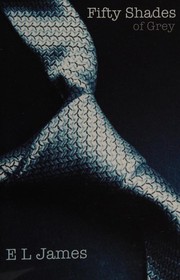 Fifty Shades of Grey, E. L. James


