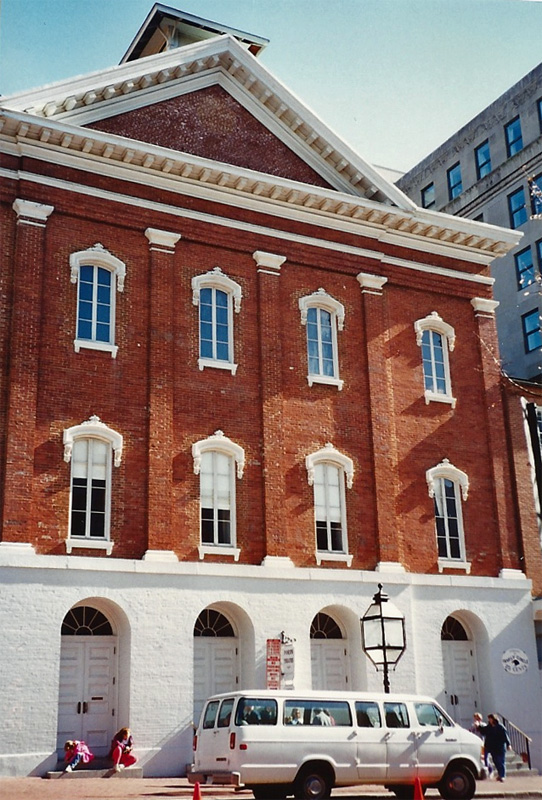
WASHINGTON, April 14 — President Abraham Lincoln was shot this evening at Ford's Theatre, in the presence of his wife and a crowded house, and now lies at the Petersen House, opposite the theatre, in a condition that leaves little hope of his recovery. The assassin, a man well known to many in the audience as the actor John Wilkes Booth, a zealous sympathizer with the rebellion, discharged a pistol at the President from behind, the ball entering the back of his head, and then, leaping upon the stage, escaped by a rear passage, mounted a horse, and rode off in the darkness toward Southern Maryland.
The President was watching the comedy "Our American Cousin," and the shot was fired at a moment when the merriment of the audience drowned the report of the weapon. So sudden and complete was the surprise that the assassin was gone before the full horror of the deed was comprehended. The wounded President was borne across the street to the house of a Mr. Petersen, where the most skilful surgeons in the city are in attendance upon him. It is feared that the wound is mortal, and the most painful anxiety pervades the community.
This fiendish act is but a part of a more extensive conspiracy, it is believed. The same evening, an attack was made upon Secretary Seward at his residence, and a plot against Vice President Johnson has been discovered.
Booth shot Lincoln once in the back of the head at Ford's Theatre while Lincoln watched the play 'Our American Cousin'.
Lincoln was taken to the Petersen House across the street from Ford's Theatre, where he died the next morning on April 15, 1865.
Booth fled on horseback to Southern Maryland and was tracked down 12 days later at a farm in rural Virginia.
Union soldier Boston Corbett fatally shot Booth in the neck after authorities set the barn ablaze where Booth was hiding.
Booth and his conspirators originally plotted to kidnap Lincoln but later decided to assassinate him, Vice President Johnson, and Secretary Seward.
Space Desk
1970 — Swigert's Call: 'Houston, We've Had a Problem'
At 200,000 miles out, an oxygen tank explosion cripples Apollo 13, forcing the crew into the lunar module for survival.
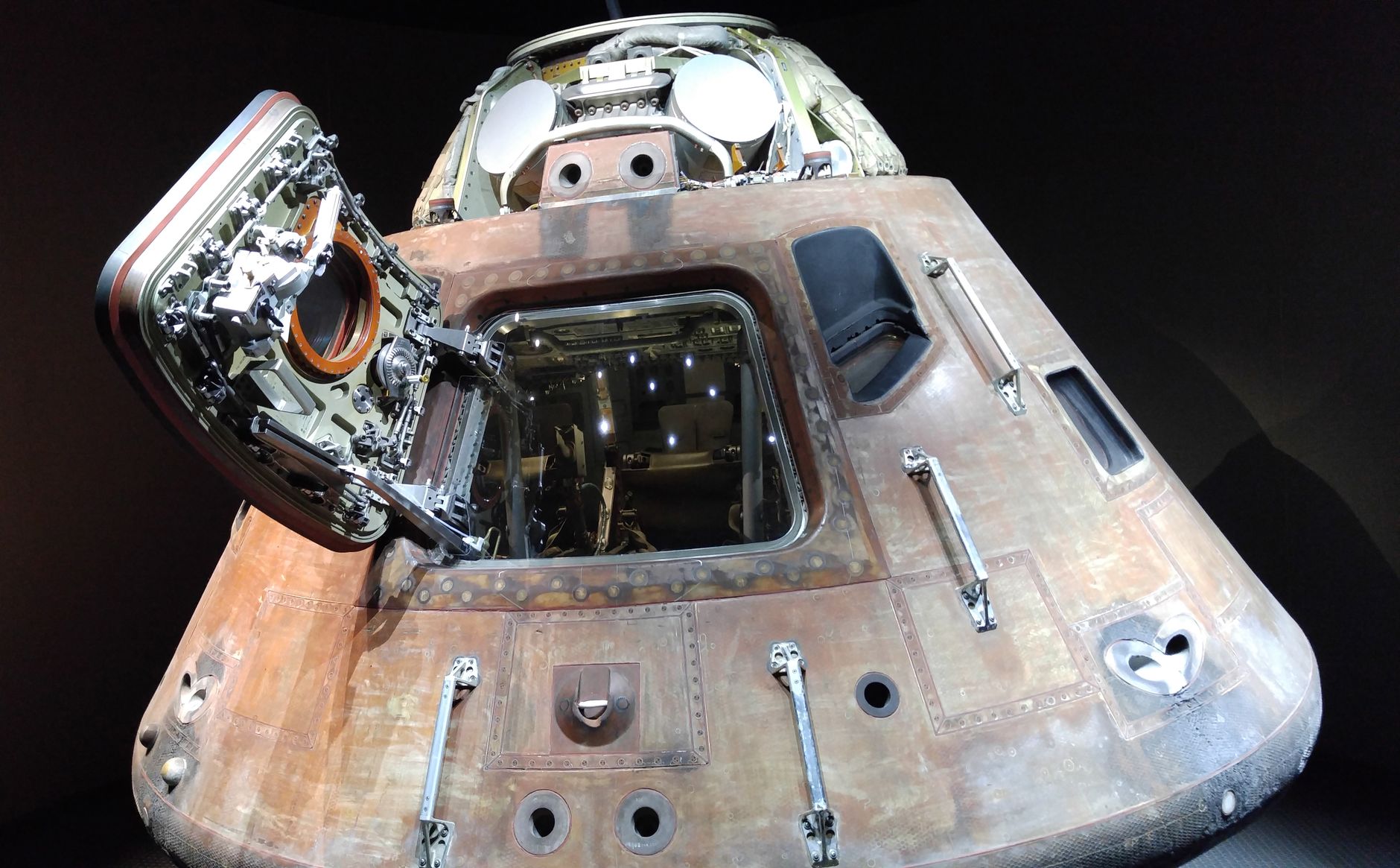
The Apollo 13 command module Odyssey, which returned the crew safely after the explosion — John McQ
HOUSTON, April 14 — The crackle of a voice from 200,000 miles out, calm and flat: "Houston, we've had a problem here." That was Jack Swigert, the command module pilot of Apollo 13, reporting the explosion of an oxygen tank in the service module two days into the mission. The blast knocked out the spacecraft's electrical and life-support systems, and the three-man crew — Lovell, Haise, and Swigert — have moved into the lunar module, which now serves as a lifeboat for the long journey back.
Mission Control has improvised procedures for a spacecraft designed for two men for two days to support three men for four. The crew has rigged the command module's carbon dioxide scrubber cartridges to work in the lunar module, a patch job that has so far kept the air breathable. Tens of millions of Americans watched the splashdown in the South Pacific on television, a recovery that will be studied for years. An investigative review board has already found fault with preflight testing of the oxygen tank and the Teflon placed inside it. The command module, Odyssey, which carried the crew home, returns to Earth with its own story to tell.
Jack Swigert, the command module pilot, reported the explosion of an oxygen tank in the service module two days into the mission.
The explosion disabled the service module's electrical and life-support systems, forcing the crew to use the lunar module as a lifeboat.
Mission Control improvised procedures for the lunar module, designed for two men for two days, to support three men for four days.
The crew and mission controllers successfully adapted command module carbon dioxide scrubber cartridges to work in the lunar module.
Tens of millions watched the splashdown of Apollo 13 in the South Pacific Ocean on television.
Europe Desk
2010 — Icelandic Ash Clouds Ground Europe's Air Travel
Eruption of Eyjafjallajökull shuts down northern skies — over 95,000 flights cancelled, losses of €148 million a day
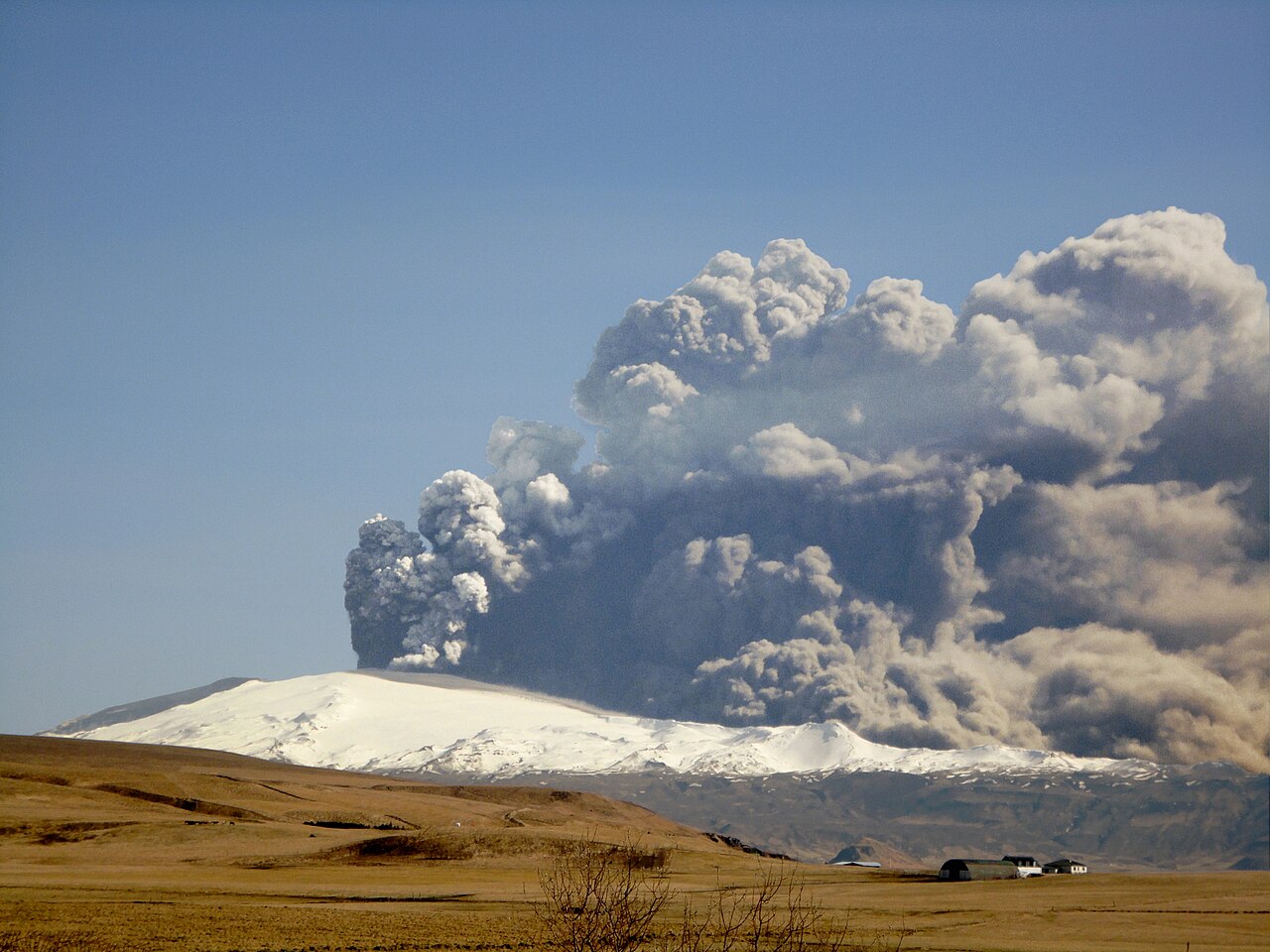
Eyjafjallajökull erupts, sending ash plumes that ground air travel across the European continent — Árni Friðriksson
LONDON, April 14 — Europe's skies have fallen silent, and the cause is a volcano in Iceland. The eruption of Eyjafjallajökull has sent a plume of ash 9 km (30,000 ft) into the air, forcing the cancellation of more than 95,000 flights across the continent in a six-day airspace ban. The International Air Transport Association estimates the airline industry is losing €148 million (US$200 million) a day. (IMAGE) The ash cloud, a vast grey curtain stretching across northern Europe, has grounded everything from transatlantic jumbos to short-haul commuters. The state funeral of Polish President Lech Kaczyński on 18 April was disrupted, with leaders including Barack Obama and Angela Merkel unable to attend.
The eruption on 14 April 2010 led to an initial uninterrupted shutdown over much of northern Europe from 15 to 23 April.
Over 95,000 flights were cancelled across Europe during the six-day airspace ban, with later figures suggesting 107,000 flights cancelled over eight days.
The International Air Transport Association estimated the airline industry worldwide would lose €148 million (US$200 million) a day during the disruption.
The second eruption phase ejected an estimated 250 million cubic metres of tephra and an ash plume that rose to around 9 km (30,000 ft).
The state funeral of Polish President Lech Kaczyński on 18 April 2010 was affected as leaders including Barack Obama and Angela Merkel were unable to attend.
Realm Chronicle
1471 — Warwick Slain at Barnet; Yorkists Triumph
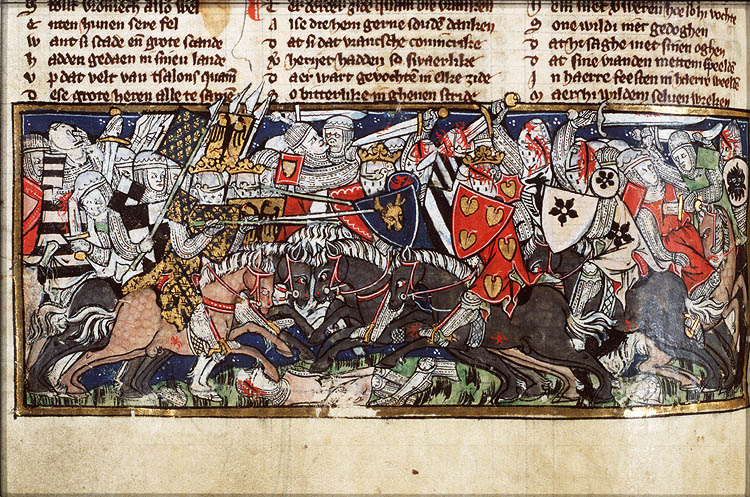
In thick mist at Barnet, Yorkist and Lancastrian forces clashed, with men striking down comrades in the confusion of battle.
The Battle of Barnet, where Yorkist forces defeated Lancastrians and killed the Earl of Warwick — Wikimedia Commons
LONDON, April 14 — In the long and bitter quarrel between the houses of York and Lancaster, this day at Barnet has turned the tide decisively for King Edward IV. In thick mist, the Yorkists met the Lancastrians, and in the confusion of battle, men struck down their own comrades, their heraldic symbols too alike to tell friend from foe.
The Battle of Barnet was fought on 14 April 1471 between Yorkists and Lancastrians.
Thick mist and similar heraldic symbols caused Lancastrians to attack their own men during the battle.
Warwick was unhorsed and killed during the rout, along with his brother John Neville, Marquess of Montagu.
Henry Holland, 3rd Duke of Exeter, was captured at Barnet and imprisoned in the Tower of London.
Poor weather prevented French reinforcements under Margaret of Anjou from joining Warwick at Barnet.
Western Plains Desk
1935 — Black Sunday Dust Storm Engulfs Oklahoma, Texas
300 million tons of topsoil stripped — AP reporter witnesses the blizzard at Boise City
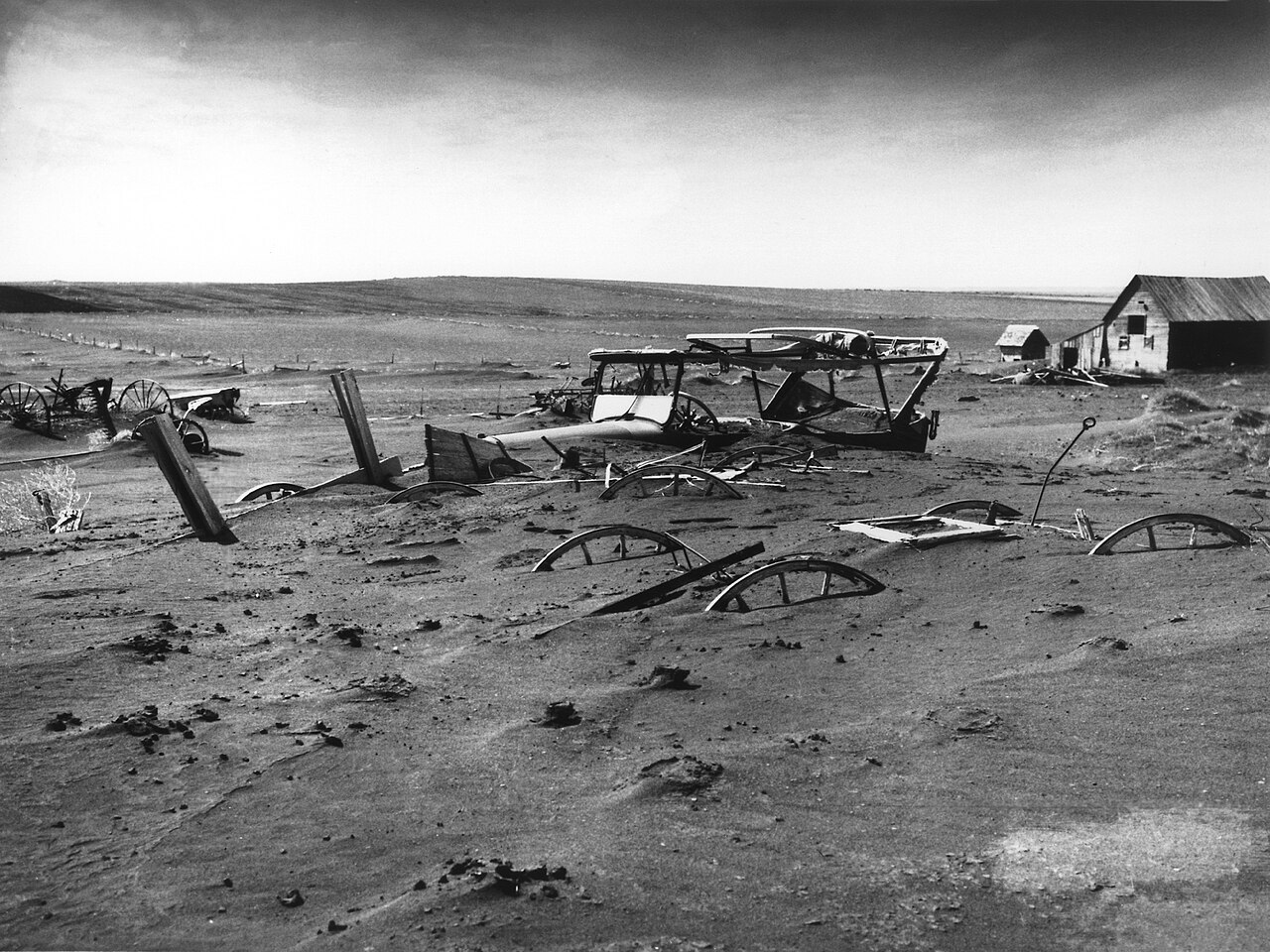
A farmstead buried in topsoil during the devastating Dust Bowl of the 1930s — Sloan (?)
BOISE CITY, Okla., April 14 — Robert E. Geiger, an Associated Press reporter, stood in Boise City as the sky turned black Sunday afternoon, watching a dust storm that stripped an estimated 300 million tons of topsoil from Oklahoma and northern Texas prairies. The day had started clear and warm, but a diving cold front from Canada plowed south at 60 mph. The only warning was static electricity and flocks of birds and rabbits fleeing south. Geiger's report later inspired the term 'Dust Bowl.'
On April 14, 1935, Black Sunday, the day started clear and warm with temperatures in the 80s and still air.
A diving cold front from Canada kicked up dust in the Dakotas and plowed south across the Great Plains at 60 mph.
The only sign of the advancing dust storm was the snapping of static electricity and flocks of screeching birds and rabbits streaming south.
Associated Press reporter Robert E. Geiger witnessed the Black Sunday blizzards in Boise City, Oklahoma.
Edward Stanley, the Kansas City news editor of the Associated Press, coined the term 'Dust Bowl' while rewriting Geiger's story.
City Desk
1999 — 500,000 Tonnes of Hail Pummels Sydney
Costliest natural disaster in Australian insurance history — A$2.3 billion damage bill
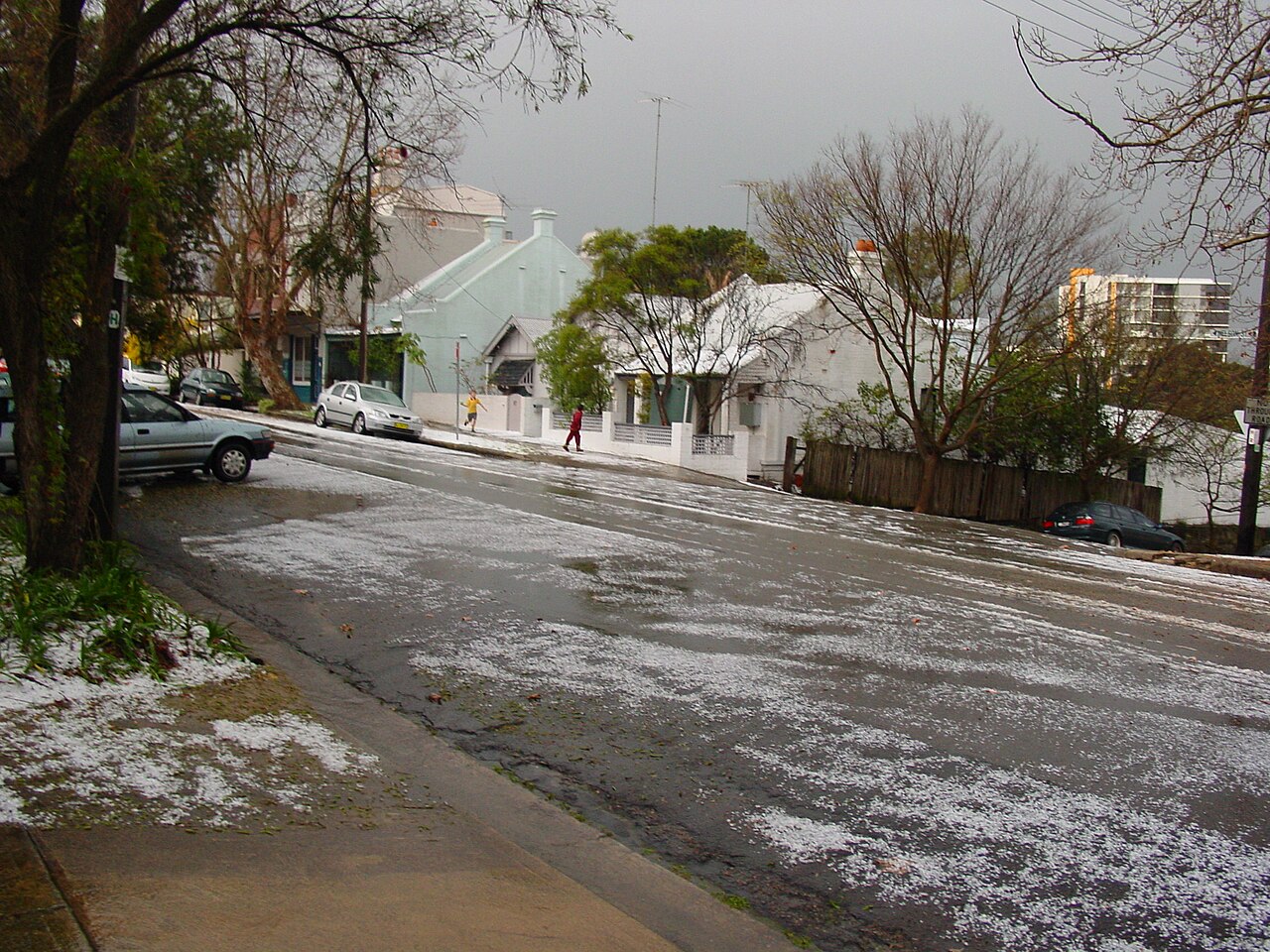
A Sydney street blanketed in hail following the costliest natural disaster in Australian history — Wikimedia Commons
SYDNEY, April 14 — Some 500,000 tonnes of hailstones slammed Sydney and the New South Wales east coast, inflicting about A$2.3 billion in damages, the costliest natural disaster in Australian insurance history. Insured losses topped A$1.7 billion. Lightning killed one person and injured roughly 50. The Bureau of Meteorology, constantly surprised by the storm's shifts in direction and severity, classified it a supercell after analysis.
The hailstorm was the costliest natural disaster in Australian insurance history, with insured damage over A$1.7 billion.
Lightning during the storm killed one person and caused approximately 50 injuries.
The storm was classified as a supercell after analysis of its erratic nature and extreme attributes.
The Bureau of Meteorology was constantly surprised by the storm's frequent changes in direction and severity.
The total damage bill, including uninsured damage, was estimated at around A$2.3 billion.
BEIJING, April 14 — A 6.9-magnitude earthquake struck Yushu Tibetan Autonomous Prefecture at 7:49 a.m. local time, killing nearly 2,700 people, with the official Xinhua news agency reporting 2,698 dead, 270 missing and 12,135 injured, including 1,434 severely. The epicenter was in Rima village, Upper Laxiu township, Yushu County, about 30 km from Gyêgu town, where the 12th-century Thrangu Monastery and surrounding villages were severely damaged, killing many monks and villagers. Rescue workers reopened Yushu Batang Airport at noon, and the first relief flight landed at 8 p.m. The American Red Cross sent an initial $50,000 in relief funds to help affected families in Qinghai.
The earthquake struck at 7:49 am local time on April 14, 2010, with a magnitude of 6.9 Mw (USGS) or 7.1 Ms (CEA).
Xinhua reported 2,698 dead, 270 missing, and 12,135 injured, including 1,434 severely.
The epicenter was in Rima village, Upper Laxiu township, Yushu County, about 30 km from Gyêgu town.
The 12th century Thrangu Monastery and surrounding villages were severely damaged, killing many monks and villagers.
Yushu Batang Airport reopened at noon on April 14, and the first rescue flight landed at 8 pm.
European Politics Desk
1931 — Second Spanish Republic Proclaimed After King Alfonso Leaves
Monarch flees after municipal election defeat — provisional government under Alcalá-Zamora takes power peacefully
MADRID, April 14 — With the royal palace empty, the Second Spanish Republic was proclaimed peacefully today, after King Alfonso XIII left Spain. The provisional government, led by Niceto Alcalá-Zamora, raised the tricolor over the capital. The king's departure followed the 12 April municipal elections, in which the Republican coalition won a sweeping majority in major cities.
On 12 April 1931, the Republican coalition won a sweeping majority in major cities in the municipal elections, seen as a plebiscite on monarchy.
Foreign minister Romanones admitted to the press an 'absolute monarchist defeat' after the election results.
Civil Guard chief José Sanjurjo reportedly told ministers the Armed Forces could not be 'absolutely' relied upon to sustain the monarchy.
Alfonso XIII fled Spain voluntarily after the elections, and the Second Spanish Republic was peacefully proclaimed on 14 April 1931.
Christendom
966 — Mieszko's Baptism Lays Foundation of Christian Poland
Duke Mieszko I's conversion in 966 joined Poland to Western Christendom, as chronicled from Gniezno on April 14.
GNIEZNO, April 14 — The baptism of Duke Mieszko I has set Poland upon the path of Western Christendom, a step that will shape the nation's destiny for ages. His conversion, completed in this year of Our Lord 966, has brought the Polish ruler and his people into the fold of the Roman Church, placing them among the civilized nations of Europe.
Mieszko I's baptism in 966 placed him and his country in the cultural sphere of Western Christianity.
He is sometimes called the 'Clovis of Poland' for his role in laying the foundations for a Christian Poland.
His marriage in 965 to the Přemyslid princess Dobrawa brought the Christian faith to Poland.
The religious vocabulary of Polish Christianity was adopted from the Czech language through Dobrawa's entourage.
The first bishop of Poland, Jordan, may have arrived with Dobrawa.
Records
1983 — Bowie's 'Let's Dance' Album Set for Release Today
Album released today finds Bowie at his most accessible
NEW YORK, April 14 — David Bowie, the chameleon of rock, unveils 'Let's Dance' today on EMI America Records, an album that finds him at his most accessible. The title track, with Stevie Ray Vaughan's biting lead guitar, is already climbing charts in advance of the LP's street date. Sessions at the Power Station in December paired Bowie with co-producer Nile Rodgers and members of Chic. For this outing, Bowie sang only, playing no instruments. The record follows his reported $17 million EMI America pact.
Let's Dance is David Bowie's fifteenth studio album, released on 14 April 1983 through EMI America Records.
The album was co-produced by Bowie and Nile Rodgers and recorded in December 1982 at the Power Station in New York City.
The sessions featured players from Rodgers' band Chic and the then-unknown Texas blues guitarist Stevie Ray Vaughan on lead guitar.
For the first time on an album, Bowie only sang and played no instruments.
The album's four singles, including the title track, were all commercially successful.
What the papers printed that morning
Real front pages from 14 April 1865, scanned by the Library of Congress. These are archival documents, not our work.
1629Christiaan HuygensChristiaan Huygens, Lord of Zeelhem was a Dutch mathematician, physicist, engineer, astronomer, and inventor who is regarded as a key figure in the Scientific Revolution.
1527Abraham OrteliusAbraham Ortelius was a cartographer, geographer, and cosmographer from Antwerp in the Spanish Netherlands.
1904John GielgudSir Arthur John Gielgud was an English actor and theatre director.
1954Katsuhiro Otomo(72 this year)Katsuhiro Otomo is a Japanese manga artist, screenwriter, animator, and film director.
1966Greg Maddux(60 this year)Gregory Alan Maddux, also known as "Mad Dog" and "the Professor," is an American former professional baseball pitcher who played 23 seasons in Major League Baseball (MLB), primarily with the Atlanta Braves and Chicago Cubs.
1925Rod SteigerRodney Stephen Steiger was an American actor, noted for his portrayal of offbeat, often volatile and crazed characters.
1919Shamshad BegumShamshad Begum was an Indian singer who was one of the first playback singers in the Hindi film industry.
1126AverroesIbn Rushd, Latinized as Averroes, was an Andalusian polymath and jurist who was proficient in a variety of intellectual fields, including philosophy, theology, medicine, astronomy, physics, psychology, mathematics, neurology, Islamic jurisprudence, law, and linguistics.
1738William Cavendish-BentinckWilliam Henry Cavendish Cavendish-Bentinck, 3rd Duke of Portland was a British Whig and then a Tory politician during the late Georgian era.
1819Harriett Ellen Grannis AreyHarriett Ellen Arey was a 19th-century American educator, author, editor, and publisher.
1827Augustus Pitt RiversLieutenant-General Augustus Henry Lane Fox Pitt Rivers was an English officer in the British Army, ethnologist, and archaeologist.
1868Peter BehrensPeter Behrens was a leading German architect, graphic and industrial designer, best known for his early pioneering AEG Turbine Hall in Berlin in 1909.
1889Arnold J. ToynbeeArnold Joseph Toynbee was an English historian, a philosopher of history, an author of numerous books and a research professor of international history at the London School of Economics and King's College London.
1922Ali Akbar KhanAli Akbar Khan was an Indian Hindustani classical musician of the Maihar gharana, known for his virtuosity in playing the sarod.
1930Arnold BurnsArnold Irwin Burns was an American lawyer.
1932Loretta LynnLoretta Lynn was an American country music singer and songwriter.
1933Yuri Oganessian(93 this year)Yuri Tsolakovich Oganessian is a Russian and Armenian nuclear physicist who is best known as a researcher of superheavy elements.
1935Susan Cunliffe-ListerSusan Lilian Primrose Cunliffe-Lister, Countess of Swinton, Lady Masham of Ilton, was a British crossbench member of the House of Lords, disability campaigner and Paralympic athlete.
1936Frank Serpico(90 this year)Francesco Vincent "Frank" Serpico is an American retired detective with the New York City Police Department (NYPD), best known for whistleblowing on police corruption.
1941Pete RosePeter Edward Rose Sr., nicknamed "Charlie Hustle", was an American professional baseball player and manager.
1964Brian AdamsBrian Keith Adams was an American professional wrestler.
1967Barrett Martin(59 this year)Barrett Harrington Martin is an American drummer and record producer from Washington.
1969Vebjørn Selbekk(57 this year)Vebjørn Selbekk is a Norwegian newspaper editor and author.
1975Anderson Silva(51 this year)Anderson da Silva is a Brazilian mixed martial artist and professional boxer.
1976Kyle Farnsworth(50 this year)Kyle Lynn Farnsworth is an American former professional baseball pitcher.
Quote of the Day
“There is nothing either good or bad, but thinking makes it so.” — William Shakespeare, Hamlet
April 14 History Quiz
What did John Wilkes Booth shout after shooting Lincoln at Ford's Theatre?
Sic semper tyrannis
Which crew member of Apollo 13 reported the oxygen tank explosion on April 14, 1970?
Jack Swigert
Which country's air travel was most disrupted by the Eyjafjallajökull eruption in 2010?
Every event on this page was picked by hand from the historical record, written up as a news report, and checked against its source. Photographs are matched to the event they illustrate and verified before they are used. Sources are linked on each story.

![Front page of New-York daily tribune, New-York [N.Y.], 14 April 1865](https://tile.loc.gov/image-services/iiif/service:ndnp:dlc:batch_dlc_cobol_ver02:data:sn83030213:00206530790:1865041401:0715/full/pct:50/0/default.jpg)

![Front page of Daily intelligencer, Wheeling, Va. [W. Va.], 14 April 1865](https://tile.loc.gov/image-services/iiif/service:ndnp:wvu:batch_wvu_austria_ver01:data:sn84026845:00202190753:1865041401:0313/full/pct:50/0/default.jpg)

 Franny and Zooey, J. D. Salinger
 “The Night The Lights Went Out In Georgia”,
  The Odessa File, Frederick Forsyth
 “Footloose”,
  The Aquitaine Progression, Robert Ludlum
 The Bourne Ultimatum, Robert Ludlum
 Dreamcatcher, Stephen King
 “We Are Young”,
  Fifty Shades of Grey, E. L. James


