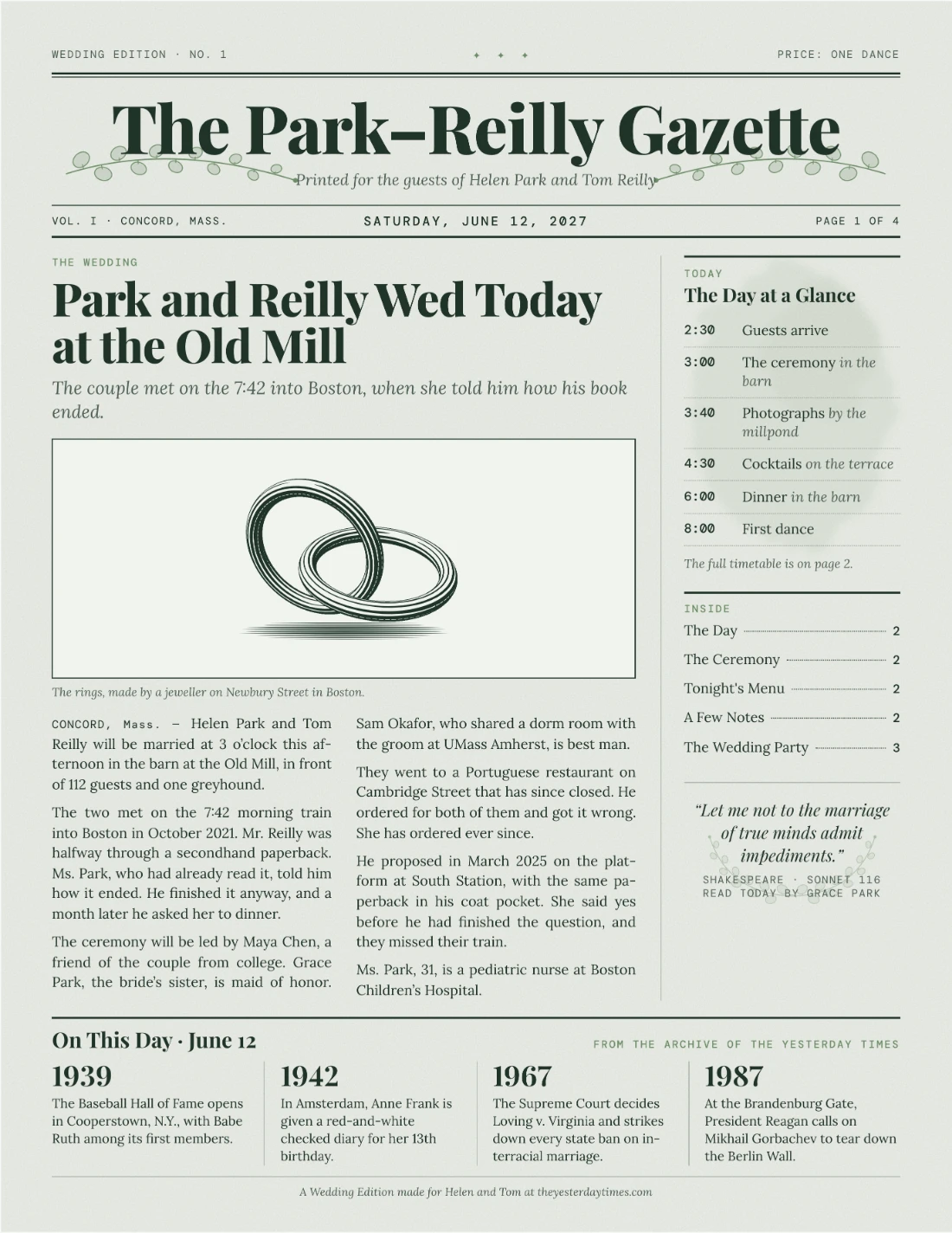
A four-page newspaper to hand your guests on the day, in place of a wedding program or an order of the day. You answer questions about the two of you, and we write the stories, set out the order of the day and build a crossword from your answers. It is free, and you download it as a PDF to print wherever you like.
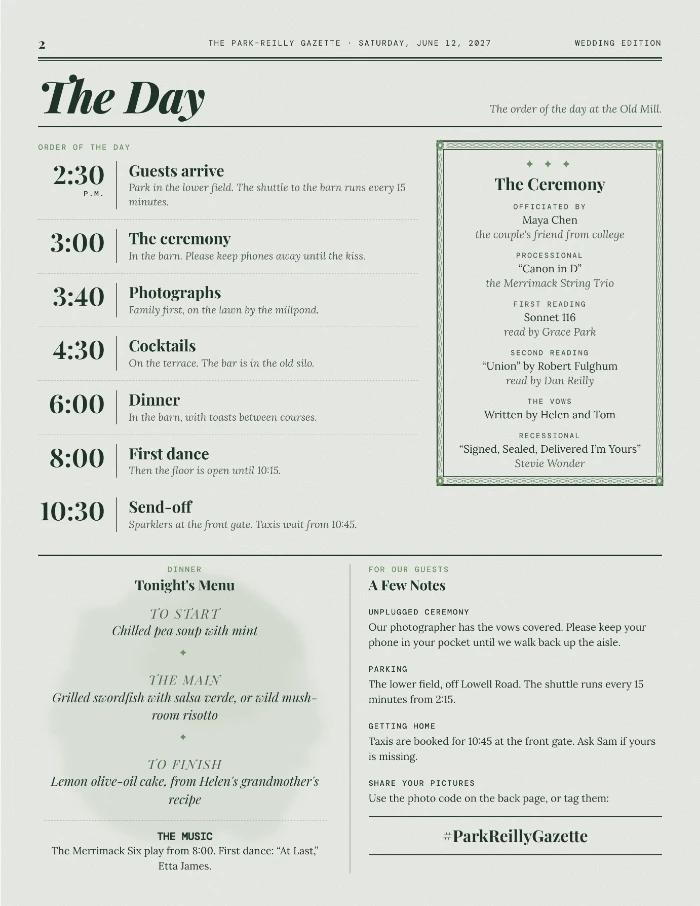
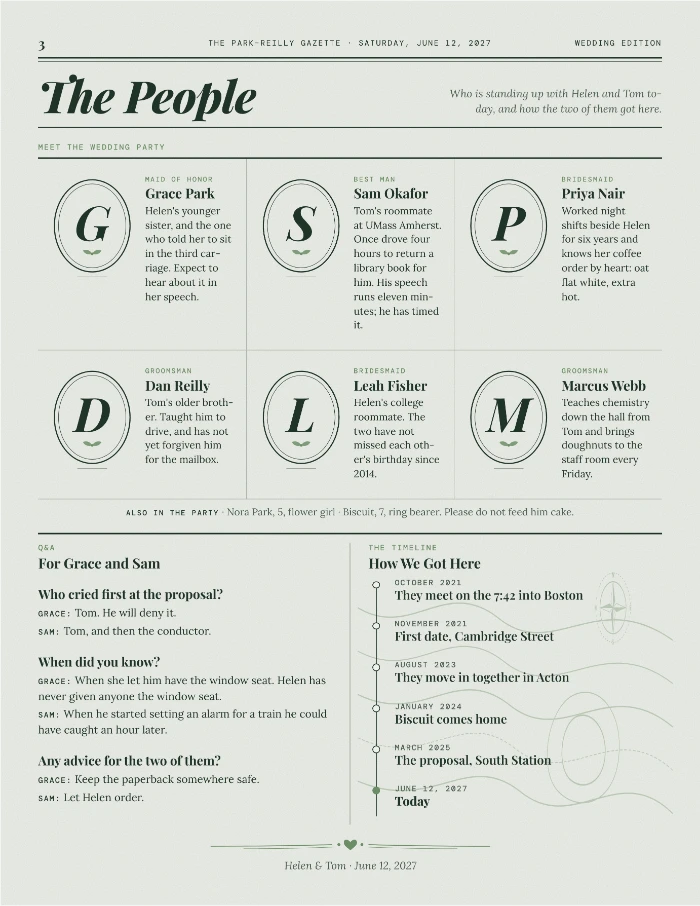
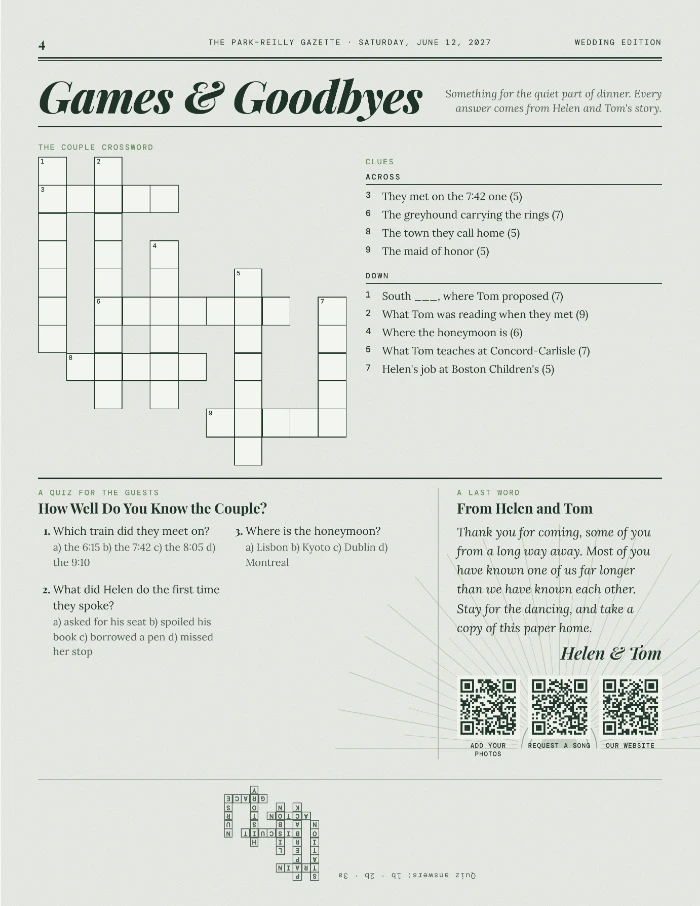
Page one is the front page: how you met or how it was asked, the day at a glance, and what happened on your wedding date in past years. Page two is the day itself, with the timetable and a section of your choosing. Page three introduces the wedding party. Page four has a crossword made from facts about you, and a note from the two of you.
After the questions you see all four pages filled in. Each page has a few spaces, and each space offers a short list of sections: swap the dress code for a menu, or the reading for travel and hotels. If a section needs answers you skipped, a small form asks for just those.
Give us six to twelve facts with one-word answers, such as the street of your first flat or the name of your dog. We build the crossword from them, so the guests who know you best finish first.
Download the four pages in order, or one sheet laid out to fold. The sheet prints double-sided on 11×17 paper, or A3 for an A4 paper; fold it once and the pages read in order. The PDF is on white, so it prints clean on any printer.
Both your names, the date and the place, the order of the day, how you met, and six facts about you. The menu, the wedding party, photos and the rest are optional.
The newspaper save-the-date is a single front page dated your wedding day, made to send to guests months before it.
Sending a save-the-date first? See the newspaper save-the-date.
About ten minutes of questions, most of it on the facts for the crossword. Then we write all four pages at once, and you can change them for as long as you like.
We do. You answer the questions, and we write the stories, build the puzzles and lay out the pages. You can rewrite any headline or story before you download.
Yes. Each page has a few spaces, and each space offers a short list of sections: a menu or a kids' corner, a reading or the dress code. The lead story and the timetable always stay. If a change leaves a page too full, we say so and offer a swap that fits.
Download the print sheet and print it double-sided on 11×17 paper, or A3 for an A4 paper, flipping on the short edge. Fold it once and the pages read in order. A copy shop can print it, and so can a home printer that takes paper that size. Plain matte paper folds cleanly and looks most like newsprint.
Yes, one for each person, and one of the two of you for the front page. Photos are optional: without them, the wedding party runs as names with a line about each person.
Yes, and we write this one for you from your answers. Making it and downloading the PDF are both free, with no watermark.
No. You get a PDF, and you print as many copies as you need wherever you like.
Yes. Choose A4 and UK spelling, and the pages are set for an A3 sheet folded to A4.