Our front page for August 27 — written and set by The Yesterday Times from the events below. Not an archival document.
Day of the year
239
Days left in 2026
126
In 2026 it falls on a
Thursday
Star sign
Virgo
Birthstone
Peridot
On August 27 in 1990, 36 years ago, Stevie Ray Vaughan Dies in Helicopter Crash. This page reports 12 stories from the date, 25 people born on this day.
The stories in full
Music Beat
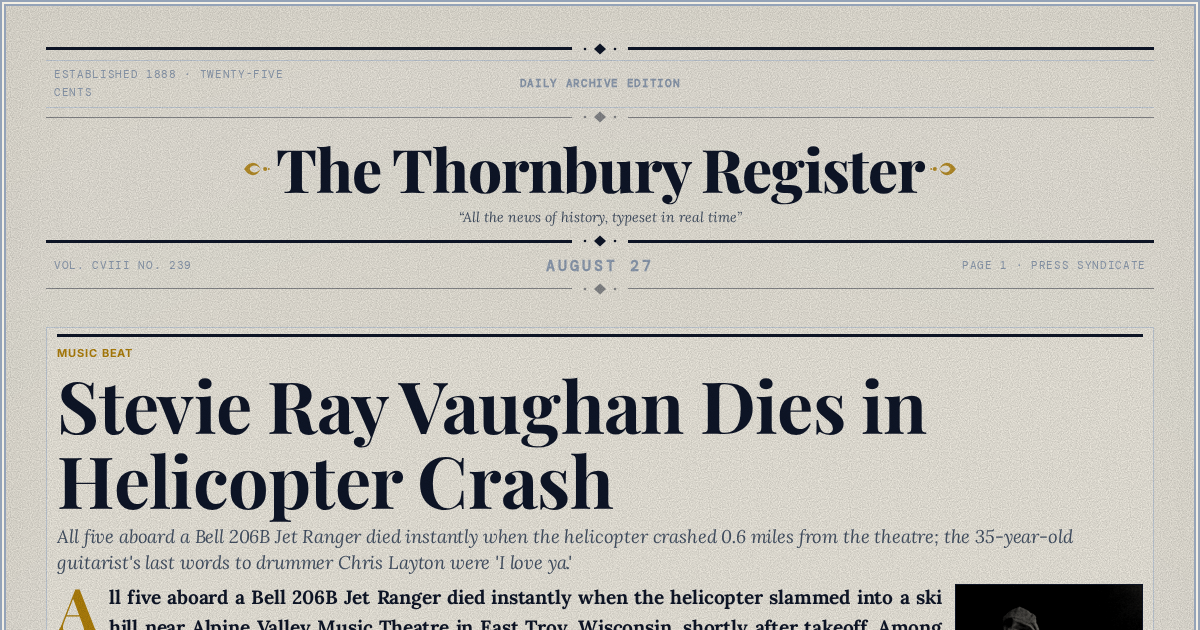
1990 — Stevie Ray Vaughan Dies in Helicopter Crash
All five aboard a Bell 206B Jet Ranger died instantly when the helicopter crashed 0.6 miles from the theatre; the 35-year-old guitarist's last words to drummer Chris Layton were 'I love ya.'
Blues guitarist Stevie Ray Vaughan performs during his influential career in the 1980s — Bbadventure
All five aboard a Bell 206B Jet Ranger died instantly when the helicopter slammed into a ski hill near Alpine Valley Music Theatre in East Troy, Wisconsin, shortly after takeoff. Among them was Stevie Ray Vaughan, 35, the Texas guitarist whose searing blues playing revived a genre in the 1980s.
The craft, piloted by Jeff Brown, departed in dense fog at 1 a.m. and crashed 0.6 miles from the theatre. Debris scattered over two hundred feet, yet there was no fire or explosion.
Vaughan's last words to drummer Chris Layton, spoken as he boarded, were simple: 'I love ya.'
The National Transportation Safety Board concluded the pilot failed to gain sufficient altitude to clear rising terrain; no mechanical failures were found.
Vaughan, known for hits like 'Pride and Joy' and his virtuosic Stratocaster work, had just played a concert at Alpine Valley with Eric Clapton and other blues luminaries. He was widely credited with bringing blues back to the mainstream after years of neglect.
A funeral is expected in Dallas, where Vaughan will be laid to rest at Laurel Land Memorial Park. More than 1,500 mourners are anticipated to attend the service on Monday.
The crash stunned the music world, which had watched Vaughan overcome addiction and reclaim his career. His brother, Jimmie Vaughan, also a guitarist, was not aboard.
As news spread, fans gathered at Austin's Steamboat, a club where Vaughan often played, leaving flowers and guitars at the door. The loss, said one promoter, was 'incalculable.'
The helicopter crashed into a ski hill near Alpine Valley Music Theatre in East Troy, Wisconsin, shortly after takeoff.
All five people on board were killed instantly; no fire or explosion occurred, and debris scattered over two hundred feet.
The NTSB concluded the pilot failed to gain sufficient altitude to avoid rising terrain, with no mechanical failures found.
Vaughan's last words to drummer Chris Layton were, 'I love ya.'
Vaughan was buried at Laurel Land Memorial Park in Dallas on August 31, 1990, with over 1,500 attending the funeral.
Aviation Desk
2006 — Comair Flight 5191 Crashes in Lexington; 49 Killed
The Bombardier CRJ100 used Runway 26 instead of Runway 22, killing 49 of the 50 people on board; first officer James Polehinke was the sole survivor.
Comair Flight 5191 crashed at 06:07 EDT on August 27, 2006, while attempting to take off from the wrong runway at Blue Grass Airport in Lexington, Kentucky, killing 49 of the 50 people on board.
The Bombardier CRJ100 used Runway 26 instead of the assigned Runway 22, which was too short for a safe takeoff. All 47 passengers and 2 of the 3 crew members were killed; first officer James Polehinke was the sole survivor.
The National Transportation Safety Board concluded that pilot error was the likely cause, with Captain Jeffrey Clay having primary responsibility for taxiing to the wrong runway. The FAA also found that tower-staffing levels violated policy, with only one controller on duty handling both tower and radar duties.
The crash has prompted the Federal Aviation Administration to modify air traffic control rules to prevent similar mistakes.
All 47 passengers and 2 of the 3 crew members were killed; first officer James Polehinke was the sole survivor.
The Bombardier CRJ100 used Runway 26 instead of the assigned Runway 22, which was too short for a safe takeoff.
The crash occurred at 06:07 EDT on August 27, 2006, at Blue Grass Airport in Fayette County, Kentucky.
The NTSB concluded that pilot error was the likely cause; Captain Jeffrey Clay had primary responsibility for taxiing to the wrong runway.
FAA discovered tower-staffing levels violated policy, with only one controller on duty handling both tower and radar duties.
Publishing Notes
1955 — Guinness Book of Records Makes Debut in Britain
A 198-page volume, born of pub arguments, bound on August 27, 1955, topped the British bestseller list by Christmas.
A thousand copies of a new 198-page book are being distributed free to pubs across Britain and Ireland, and the volume is already climbing the charts.
The Guinness Book of Records, bound on August 27, 1955, was conceived by Sir Hugh Beaver to settle arguments debated in pubs. Twin brothers Norris and Ross McWhirter, commissioned on September 14, 1954, compiled the facts.
The book topped the British bestseller list by Christmas. Next year, New York publisher David Boehm will introduce it to the United States, where it is expected to sell 70,000 copies.
Sir Hugh Beaver created the concept to settle arguments debated in pubs.
Twin brothers Norris and Ross McWhirter co-founded the book in London in late August 1955.
The first 198-page edition was bound on 27 August 1955 and topped the British bestseller list by Christmas.
A thousand copies were distributed for free to pubs across Britain and Ireland as a promotional asset.
The McWhirters were commissioned on 14 September 1954 to compile the book.
Chronicle of the Fall
410 — Rome Falls to Visigoths; City Sacked for Three
First foreign conquest in 800 years shakes the Empire; St. Jerome laments, 'the city which had taken the whole world was itself taken'
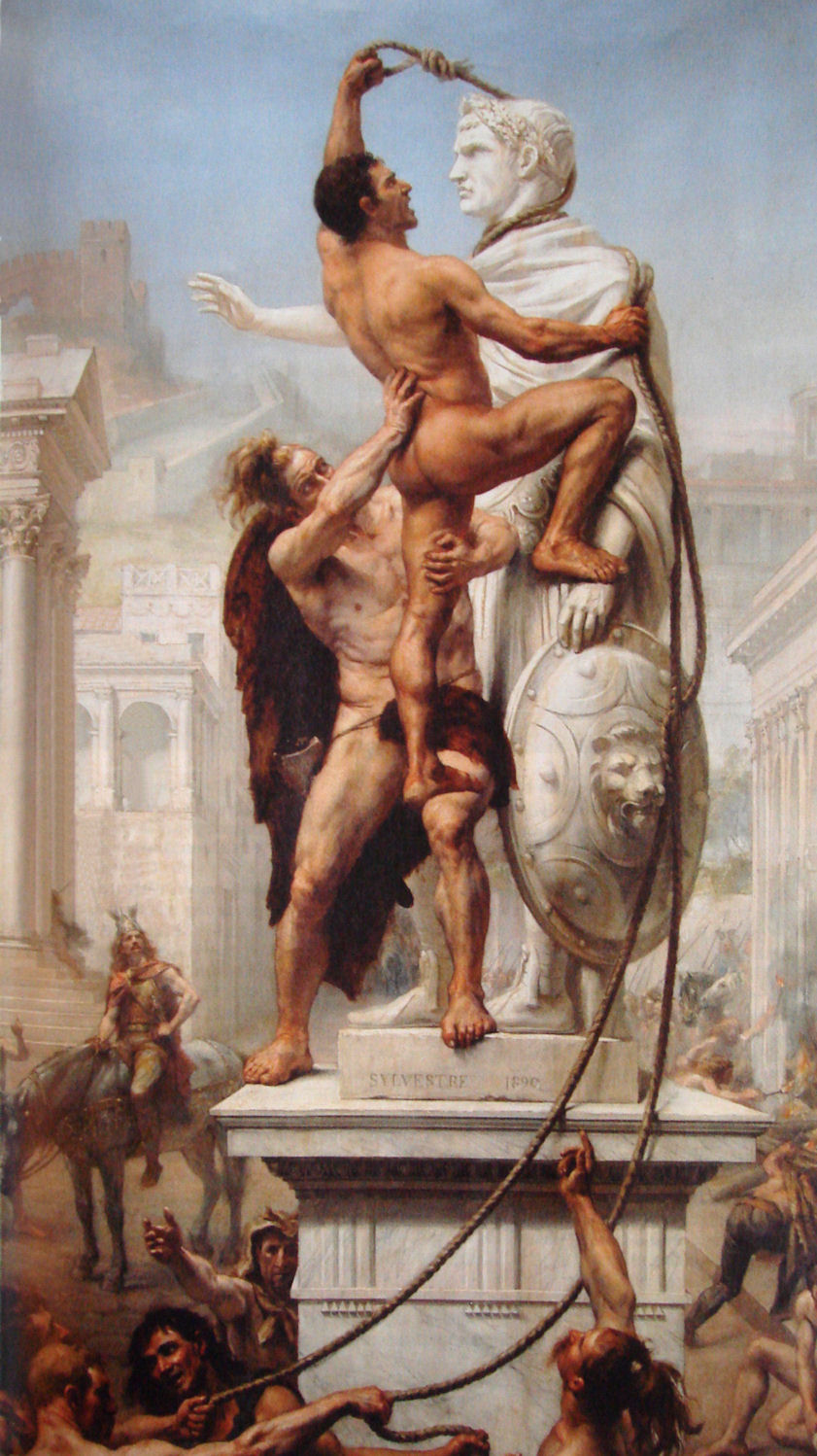
Visigoths desecrate Roman monuments as the three-day sack of the Eternal City concludes — Joseph-Noël Sylvestre
For the first time in almost 800 years, Rome has fallen to a foreign enemy, and the shock is reverberating across the civilized world.
The Visigoths, led by their king Alaric, entered the city on August 24 and spent three days in pillage and plunder. The Eternal City, which had not seen a foreign conqueror since the Gauls in 390 BC, is now in ruins, its monuments desecrated.
St. Jerome, writing from Bethlehem, cried out: 'the city which had taken the whole world was itself taken.'
Though Alaric was a Christian and spared the churches of St. Peter and St. Paul, the psychological blow is immense. The sack is seen as a major landmark in the fall of the Western Roman Empire, a symbol of its waning power.
Rome had been the heart of an empire that stretched from Britain to the Euphrates. Its fall sends a message to all provinces: no city is invincible, no power eternal. The Visigoths, who had been seeking settlement within the empire for years, turned to violence after negotiations with the emperor Honorius broke down.
Alaric's troops, weary of broken promises, took what they could. The city's wealth, accumulated over centuries, has been stripped. Many Romans have been taken as slaves, while others have fled to the countryside.
The long-term consequences are yet to unfold, but the event marks a turning point in the slow disintegration of Roman authority in the West.
The sack of Rome on 24 August 410 AD was undertaken by the Visigoths led by their king, Alaric.
This was the first time in almost 800 years that Rome had fallen to a foreign enemy.
St. Jerome wrote: 'the city which had taken the whole world was itself taken'.
The sack of 410 is seen as a major landmark in the fall of the Western Roman Empire.
Foreign Despatches
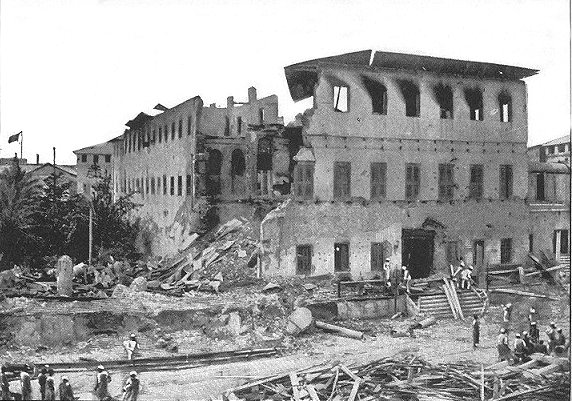
1896 — Zanzibar Yields in 38 Minutes
The shortest war in history ends as the Sultan's flag falls under British fire.
The Sultan's palace in Zanzibar following the British bombardment in 1896 — Richard Mohun
In an age of imperial rivalries, few conflicts have been so brief as to seem a mere exchange of courtesies, yet the war between the Sultanate of Zanzibar and the United Kingdom, concluded this day, holds the record for brevity. At 09:02 the British opened bombardment; by 09:46 the palace flag was shot down and fire ceased, the whole affair lasting between 38 and 45 minutes. Two cruisers, three gunboats, 150 marines, and 900 Zanzibari troops faced Sultan Khalid's force of some 2,800, including guards, servants, and slaves. Roughly 500 of the Sultan's men fell; but one British sailor was injured. Khalid has taken asylum in the German consulate.
The conflict lasted between 38 and 45 minutes, making it the shortest recorded war in history.
At 09:02 the British opened bombardment; by 09:46 the palace flag was shot down and fire ceased.
The British deployed two cruisers, three gunboats, 150 marines, and 900 Zanzibari troops.
Sultan Khalid's defending force numbered around 2,800, including palace guards, servants, and slaves.
The sultan's forces suffered roughly 500 casualties, while only one British sailor was injured.
America at War
1776 — Howe Defeats Washington on Long Island
British victory secures New York port, though a Maryland stand saves the army.
General George Washington, commanding the Continental Army, has suffered a severe defeat at the hands of General William Howe, whose 32,000 troops landed on Staten Island and overwhelmed the American lines on Long Island. The battle proved the largest of the Revolutionary War in troop deployment and combat. A gallant stand by 400 Maryland and Delaware troops prevented greater American losses during the British flank attack. Washington now faces the prospect of evacuating his entire army from Brooklyn Heights to Manhattan, a maneuver he is expected to attempt on the night of August 29–30. The British thereby gain access to the strategically important Port of New York.
The British landed 32,000 troops on Staten Island under General William Howe.
The battle was the largest of the Revolutionary War in troop deployment and combat.
A stand by 400 Maryland and Delaware troops prevented greater American losses during the British flank attack.
Washington evacuated the entire army from Brooklyn Heights to Manhattan on the night of August 29–30 without losing supplies or a single life.
The British gained access to the strategically important Port of New York, which they held for the rest of the war.
Naval Intelligence
1810 — French Squadron Humiliates Royal Navy at Grand Port
A French squadron repulses a British attack in a devastating naval defeat.
The Royal Navy has suffered one of its worst defeats of the Napoleonic Wars at Grand Port, where the French squadron under Captain Guy-Victor Duperré repulsed the British attack. The French lost no ships in the engagement, though Duperré himself was badly wounded.
The battle was fought from 20 to 27 August 1810 over the harbour of Grand Port on Isle de France.
British commander Captain Samuel Pym ordered his frigates to attack French warships on 22 and 23 August.
Two British frigates were irretrievably grounded, one struck her colours, and a fourth could not close to effective gun range.
The French squadron was commanded by Captain Guy-Victor Duperré.
The battle was one of the worst defeats suffered by the British navy during the Napoleonic Wars.
Saigon Politics
1964 — Khanh Takes Two Rivals Into Triumvirate Rule
Junta leader Nguyễn Khánh shares power with generals Trần Thiện Khiêm and Dương Văn Minh, both of whom plotted against him.
Saigon, Aug. 27 — Junta leader Nguyễn Khánh entered a triumvirate with rival generals Trần Thiện Khiêm and Dương Văn Minh, both implicated in plots against him. Khiêm was tied to the September coup attempt; Minh had led the 1963 assassination of Diệm.
The triumvirate included rival generals Trần Thiện Khiêm and Dương Văn Minh, both involved in plots to unseat Khánh.
Khiêm had been implicated in the September 1964 coup attempt by Generals Lâm Văn Phát and Dương Văn Đức.
Minh had led the 1963 coup that assassinated President Ngô Đình Diệm and was toppled by Khánh in January 1964.
Khánh allowed Minh to stay on as a token head of state after the January 1964 coup to capitalize on Minh's public standing.
Far East Desk
2009 — Junta, Ethnic Armies Clash in Kokang; 30,000 Flee to China
On August 27, fighting for a third day sent as many as 30,000 refugees into Yunnan.
Smoke rose over the Kokang hills near the Chinese border on August 27 as Myanmar junta troops and ethnic armies fought for a third day. The MNDAA raided a police checkpoint, opening fire on junta forces. As many as 30,000 refugees fled to Yunnan in China.
As many as 30,000 refugees fled to Yunnan in neighbouring China as a result of the conflict.
The MNDAA lost control of the area after clashes with the Burmese military junta forces.
On 27 August, the MNDAA raided a police checkpoint near the border, opening fire on junta troops.
The Myanmar Army's operation was overseen by Min Aung Hlaing, who was credited for it by the junta.
The junta reported 26 troops killed and 47 wounded, with eight rebel bodies found, though figures were unconfirmed.
Music Notes
1953 — Canadian Guitarist, Singer-Songwriter Alex Lifeson Born
Alex Lifeson, who would become a noted Canadian guitarist, singer-songwriter, and producer, was born today.
A future force in rock music arrived today with the birth in Canada of Alex Lifeson, a guitarist, singer-songwriter, and producer. His career would later flourish with the band Rush, known for intricate compositions. Lifeson's work would influence a generation of musicians with its distinctive style.
Alex Lifeson, Canadian singer-songwriter, guitarist, and producer
Frontier Chronicle
1832 — Black Hawk Surrenders, Ending War With Sauk
In 1832, Black Hawk surrendered to United States authorities, ending the Black Hawk War.
The Black Hawk War closed in August 1832 when Sauk leader Black Hawk surrendered. He and Wabokieshiek gave themselves up to Lieutenant Jefferson Davis on a Mississippi River island. They had first sought Indian agent Joseph Street but were taken to Zachary Taylor instead. The conflict, which included the Bad Axe confrontation, thus came to an end.
On August 27, 1832, Black Hawk and Wabokieshiek surrendered to Lieutenant Jefferson Davis, future president of the Confederacy, on an unnamed Mississippi River island.
They had first asked to surrender to Indian agent Joseph Street but were taken to Zachary Taylor instead.
The surrender ended the Black Hawk War, which had lasted from April to August 1832 and included the final Bad Axe confrontation.
Music Desk
1956 — English Bassist Glen Matlock Born
Glen Matlock, an English singer-songwriter and bass player, was born today.
Glen Matlock, an English singer-songwriter and bass player, was born today. He would later become a founding member of the Sex Pistols, a band that shook the music world. Matlock's bass lines and songwriting contributed to the punk rock movement. His birth marks a significant moment for English music.
Glen Matlock, English singer-songwriter and bass player
What the papers printed that morning
Real front pages from 27 August 1955, scanned by the Library of Congress. These are archival documents, not our work.
1953Alex Lifeson(73 this year)Aleksandar Živojinović, known professionally as Alex Lifeson, is a Canadian musician, best known as the guitarist for the rock band Rush.
1956Glen Matlock(70 this year)Glen Matlock is an English musician and the bass guitarist in the original line-up of the punk rock band the Sex Pistols.
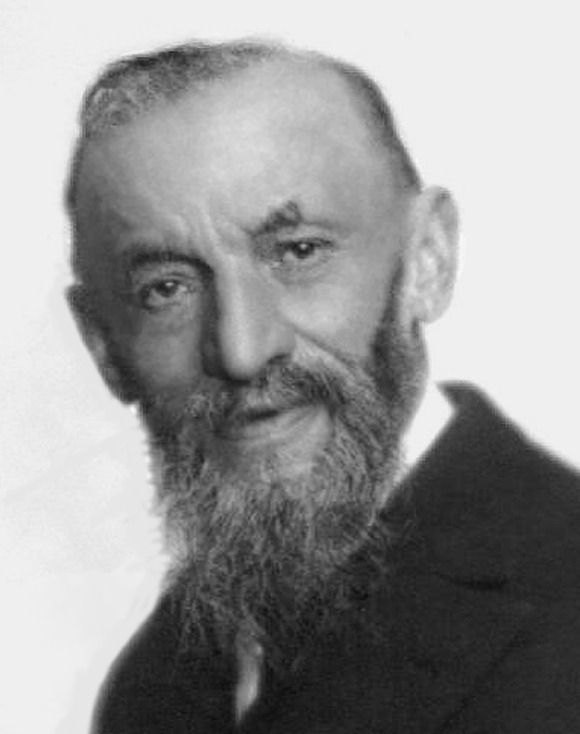
1858Giuseppe PeanoGiuseppe Peano was an Italian mathematician and glottologist.
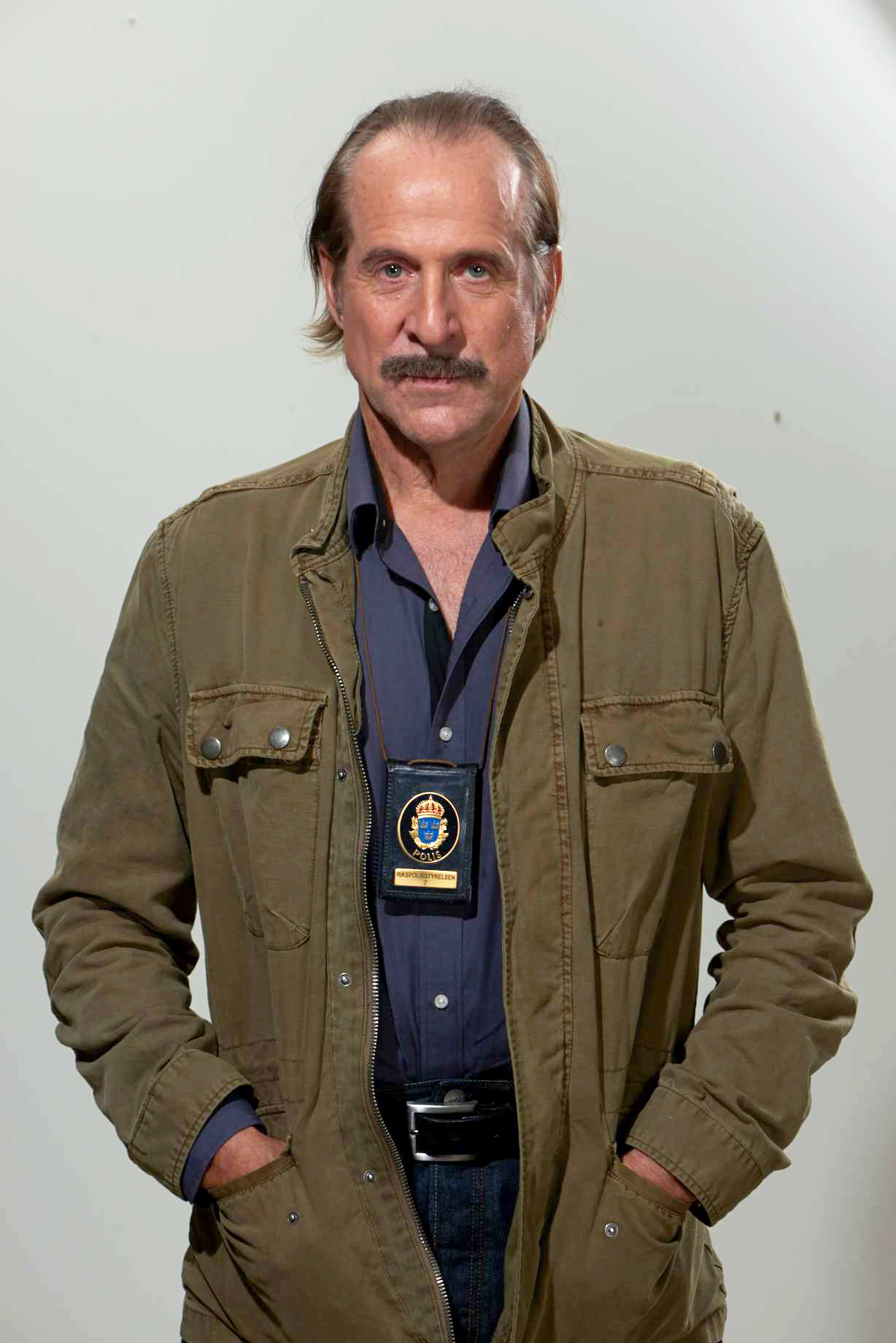
1953Peter Stormare(73 this year)Rolf Peter Ingvar Stormare is a Swedish and American actor.
1962Adam Oates(64 this year)Adam Robert Oates is a Canadian former professional ice hockey player, former co-head coach for the New Jersey Devils and former head coach for the Washington Capitals.
1986Mario(40 this year)Mario Dewar Barrett, known mononymously as Mario, is an American R&B singer, songwriter and dancer.
1992Kim Petras(34 this year)Kim Petras is a German singer and songwriter based in Los Angeles.
865RhazesAbū Bakr al-Rāzī, also known as Rhazes, 864 or 865 – 925 or 935 CE, was a Persian physician, philosopher and alchemist who lived during the Islamic Golden Age.
1637Charles CalvertCharles Calvert, 3rd Baron Baltimore was an English colonial administrator.
1795Giorgio MitrovichGiorgio Mitrovich was a Maltese patriot and politician known for his role in the struggle for freedom of the press in Malta.
1884Denis G. LillieDenis Gascoigne Lillie was a British biologist who participated in the Terra Nova Expedition (1910–1913) to the Antarctic.
1915Norman Foster Ramsey Jr.Norman Foster Ramsey Jr. was an American physicist who was awarded the 1989 Nobel Prize in Physics for the invention of the separated oscillatory field method, which had important applications in the construction of atomic clocks.
1924Rosalie E. WahlSara Rosalie Wahl was an American feminist, lawyer, public defender, clinical law professor, and judge.
1928Péter Boross(98 this year)Péter Boross is a Hungarian retired politician and former member of the Hungarian Democratic Forum (MDF) who served as Prime Minister of Hungary from December 1993 to July 1994.
1931Sri ChinmoyChinmoy Kumar Ghose, better known as Sri Chinmoy, was an Indian spiritual leader who taught meditation in the United States after moving to New York City in 1964.
1937Alice ColtraneAlice Lucille Coltrane, also known as Swamini Turiyasangitananda or simply Turiya, was an American jazz musician, composer, bandleader, and Hindu spiritual leader.
1941Cesária ÉvoraCesária Évora GCIH was a Cape Verdean singer known for singing morna, a genre of music from Cape Verde, in her native Cape Verdean Creole.
1944Tim BogertJohn Voorhis "Tim" Bogert III was an American multi-instrumentalist musician and frequent collaborator with drummer Carmine Appice; the duo performed in such bands as Vanilla Fudge, Cactus, and the power trio Beck, Bogert & Appice..
1950Charles Fleischer(76 this year)Charles Fleischer is an American actor, stand-up comedian, musician, and writer, best known for his recurring role as Carvelli in Welcome Back, Kotter, and for appearing in films such as Who Framed Roger Rabbit, A Nightmare on Elm Street, The Polar Express, Rango, Chip 'n Dale: Rescue Rangers, and We're Back!
1961Yolanda Adams(65 this year)Yolanda Yvette Adams is an American gospel singer, actress, and host of her own nationally syndicated morning gospel show.
1968Daphne Koller(58 this year)Daphne Koller is an Israeli-American computer scientist.
1969Avril Haines(57 this year)Avril Danica Haines is an American lawyer who served as the Director of National Intelligence in the Biden administration.
1969Chandra Wilson(57 this year)Chandra Danette Wilson is an American actress and director best known for her role as Dr. Miranda Bailey in Grey's Anatomy, for which she won a Screen Actors Guild Award for Outstanding Performance by a Female Actor in a Drama Series and two NAACP Image Award for Outstanding Supporting Actress in a Drama Series.
1973Johan Norberg(53 this year)Johan Norberg is a Swedish author devoted to promoting economic globalization and classical liberal positions.
1974Aaron Downey(52 this year)Aaron Douglas Downey is a Canadian professional ice hockey coach and former player.
Quote of the Day
“The supreme art of war is to subdue the enemy without fighting.” — Sun Tzu (trans. Lionel Giles), The Art of War
August 27 History Quiz
Which guitarist, born on August 27, was a founding member of Rush?
Alex Lifeson
The first Guinness Book of Records was published in which year?
1955
The Battle of Long Island in 1776 was a victory for which army?
Every event on this page was picked by hand from the historical record, written up as a news report, and checked against its source. Photographs are matched to the event they illustrate and verified before they are used. Sources are linked on each story.



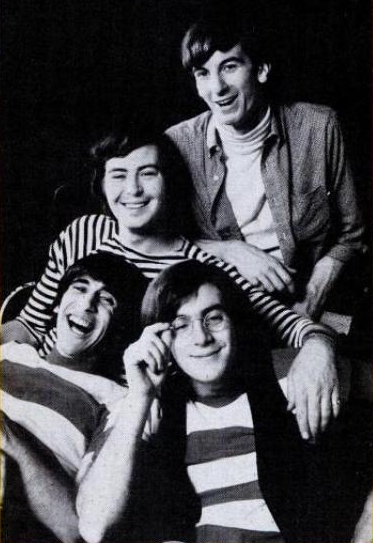 “Summer In The City”,
  Valley of the Dolls, Jacqueline Susann
 “Best Of My Love”,
  The Thorn Birds, Colleen McCullough
 “Every Breath You Take”,
  “I'll Make Love To You”,
  Lifeguard, James Patterson and Andrew Gross
 “Last Friday Night (T.G.I.F.)”,
  Cold Vengeance, Douglas Preston and Lincoln Child
 Where the Crawdads Sing, Delia Owens