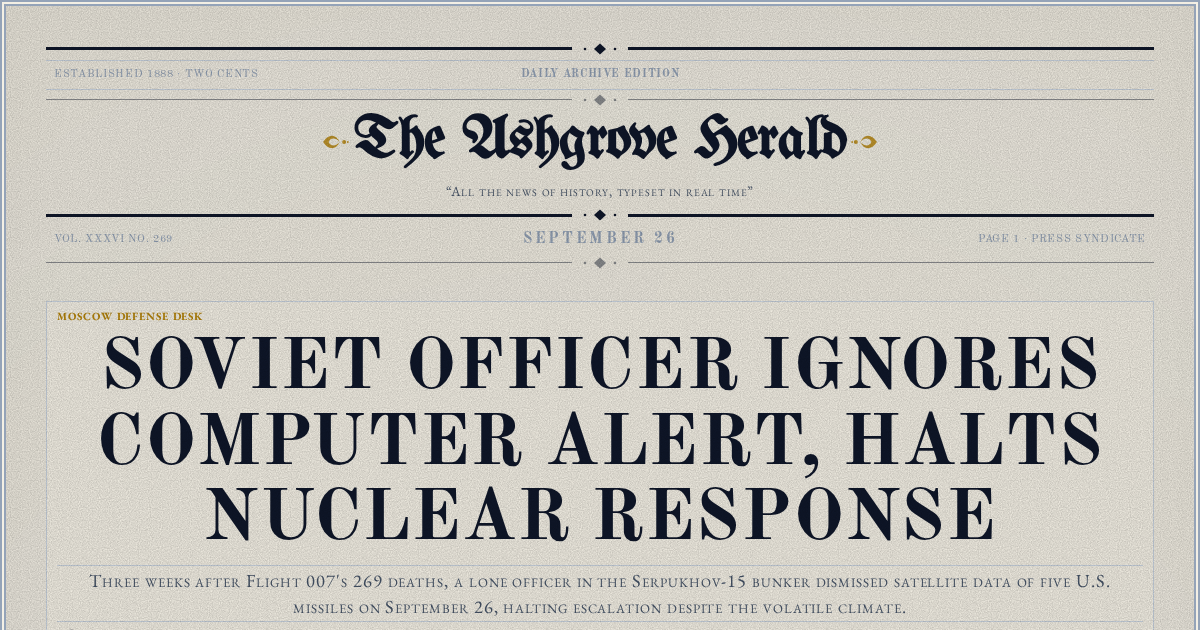
Our front page for September 26 — written and set by The Yesterday Times from the events below. Not an archival document.
Day of the year
269
Days left in 2026
96
In 2026 it falls on a
Saturday
Star sign
Libra
Birthstone
Sapphire
On September 26 in 1983, 43 years ago, Soviet Officer Ignores Computer Alert, Halts Nuclear Response. This page reports 10 stories from the date, 25 people born on this day.
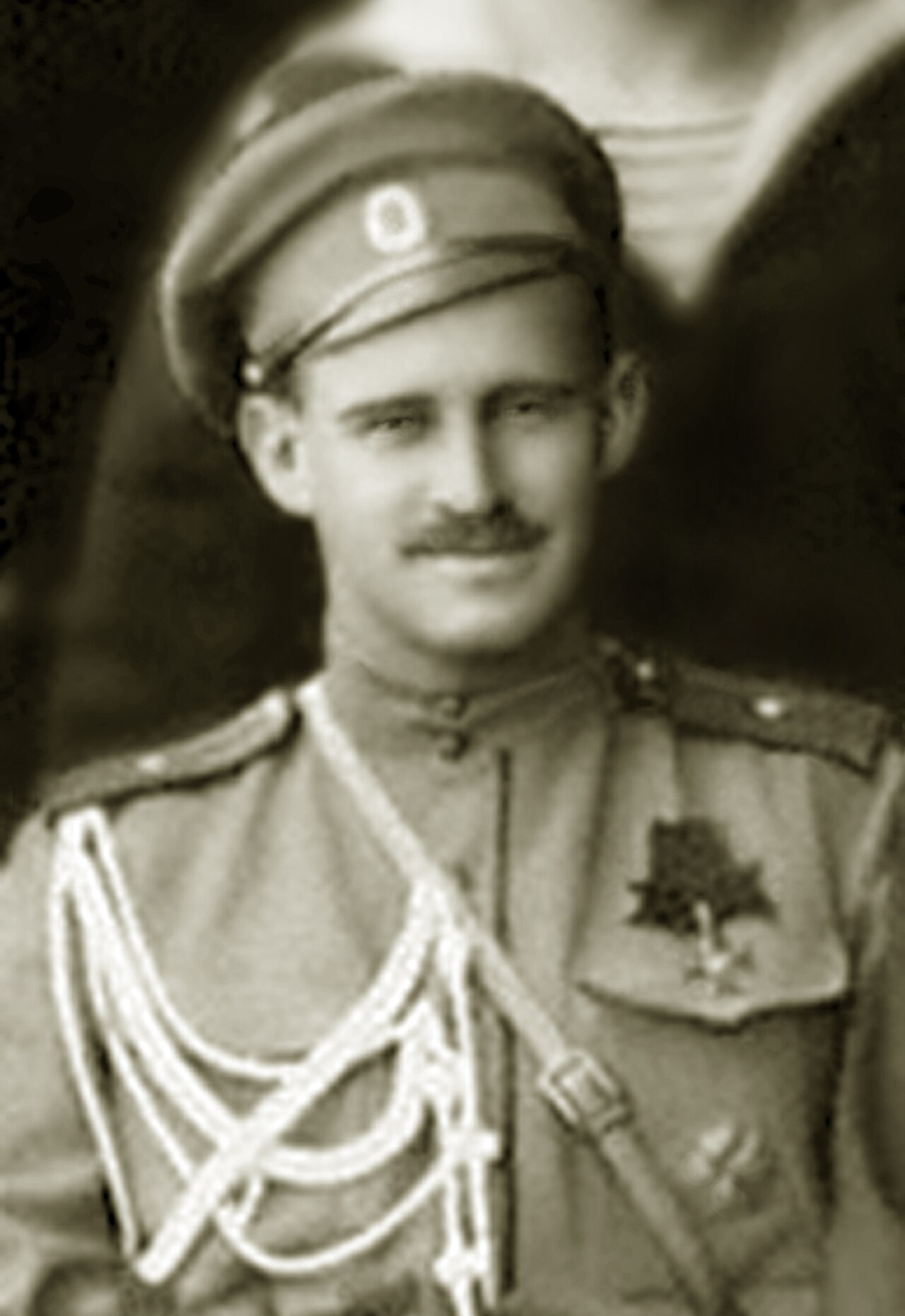
Three weeks after Flight 007's 269 deaths, a lone officer in the Serpukhov-15 bunker dismissed satellite data of five U.S. missiles on September 26, halting escalation despite the volatile climate.
Soviet Air Force officer Stanislav Petrov in uniform — Wikimedia Commons
MOSCOW, September 26 — Five.
That was the count flashing across Lieutenant Colonel Stanislav Petrov's console at the Serpukhov-15 bunker near Moscow early this morning. The Oko early-warning system reported one intercontinental ballistic missile launched from the United States, then escalated to as many as four more. Petrov, the duty officer, judged the alert a false alarm and declined to escalate to command. His reasoning: a genuine American first strike would be all-out, not five missiles.
The incident came three weeks after Soviet forces shot down Korean Air Lines Flight 007, killing all 269 aboard and leaving East-West relations at their most volatile in years. In that climate, the Oko reading carried exceptional danger.
Military investigators later traced the false alarm to a rare alignment of sunlight on high-altitude clouds above North Dakota, which the satellite system misread as missile launches.
Petrov has been reprimanded for improper paperwork filing and reassigned to a less sensitive post, according to sources familiar with the matter. The officer at his desk in uniform made a split-second choice that held back the machinery of retaliation.
Lieutenant colonel Stanislav Petrov was the duty officer at the Serpukhov-15 bunker near Moscow on 26 September 1983.
The Oko early-warning system reported one intercontinental ballistic missile launched from the United States, followed by up to four more.
Petrov judged the reports to be a false alarm, citing that a U.S. first strike would be all-out, so five missiles seemed illogical.
The false alarm was later determined to be caused by a rare alignment of sunlight on high-altitude clouds above North Dakota.
The incident occurred three weeks after the Soviet military shot down Korean Air Lines Flight 007, killing all 269 aboard.
Third Annus Mirabilis publication — clerk questions Newton's universe
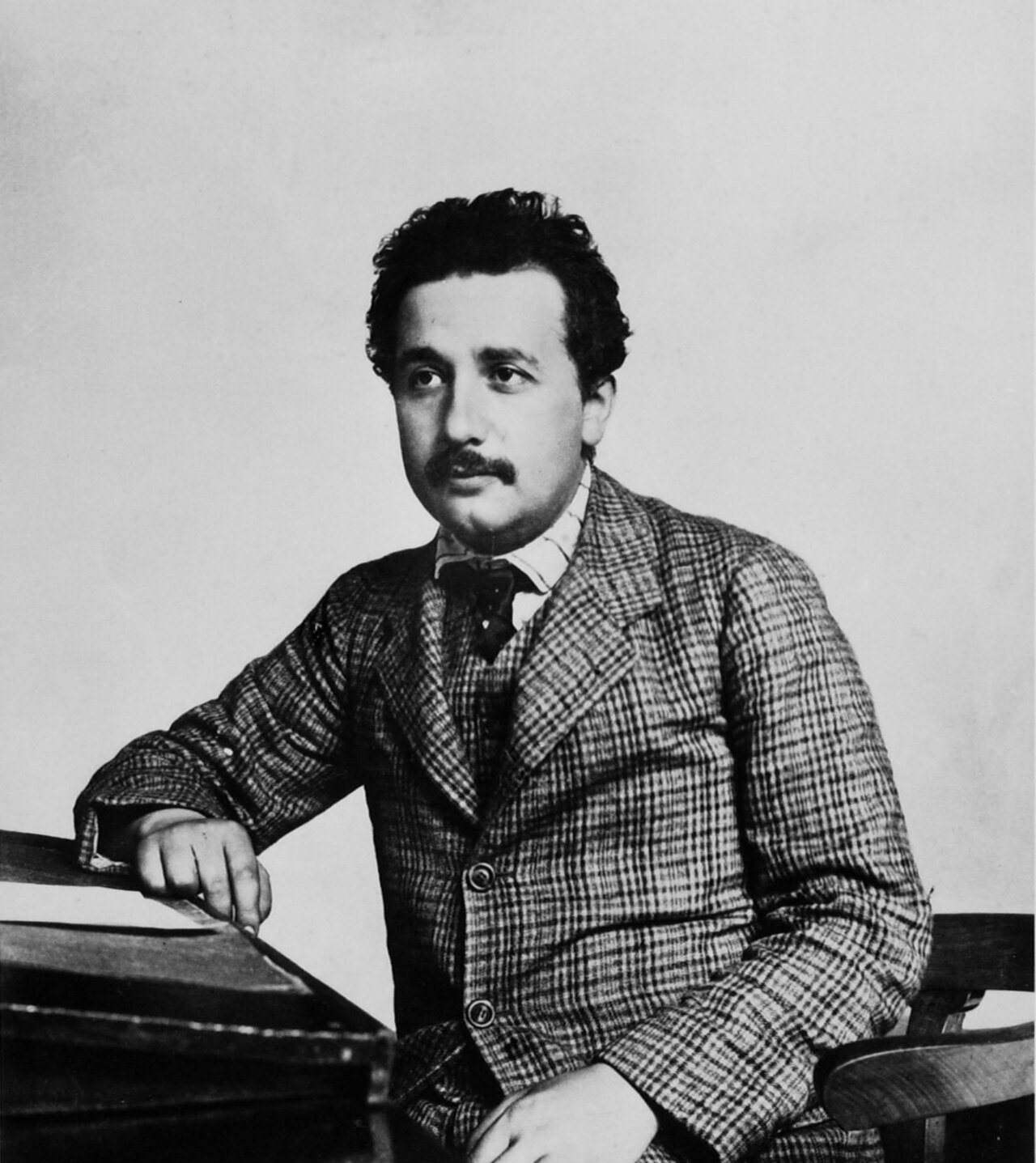
the physicist at his desk in the patent office year of the miracle — Wikimedia Commons
BERN, September 26 — Albert Einstein today published the third of his Annus Mirabilis papers, introducing the special theory of relativity and overturning the classical mechanics that have governed physical science since Newton.
The physicist, still employed at his desk in the patent office during this year of the miracle, argues that time and space are not absolute but depend upon the observer's motion. The work follows his papers on the photoelectric effect and Brownian movement.
Einstein's mathematics predict that no object can exceed the speed of light and that mass itself contains energy, a proposition with consequences yet to be measured.
Albert Einstein publishes the third of his Annus Mirabilis papers, introducing the special theory of relativity.
Final offensive — battle to end when Germany surrenders
VERDUN, September 26 — Along the Meuse River and through the Argonne Forest, American and French batteries opened fire before dawn. The Meuse-Argonne Offensive has begun, a campaign that commanders expect will continue until the total surrender of German forces ends the Great War.
World War I: The Meuse-Argonne Offensive began which would last until the total surrender of German forces.
1984 — Britain Agrees to Return Hong Kong to China in 1997
Sovereignty transfer settled — 156 years of rule to end
LONDON, September 26 — The British Empire's 156-year hold on Hong Kong will end with the turn of the century. The United Kingdom and China today agreed to a transfer of sovereignty over the territory, to take place in 1997.
The United Kingdom and China agree to a transfer of sovereignty over Hong Kong, to take place in 1997.
1968 — Beatles Cap Marathon Session, Finish 'Warm Gun' at Dawn
1968 — After three nights in Studio Two, the band completes John Lennon's composition, hailed by all four as the album's finest track.
LONDON, September 26 — In the small hours of this morning, The Beatles completed recording of "Happiness Is a Warm Gun" at 5 a.m., capping a marathon that began Thursday evening at EMI Studios and stretched across fifty-three takes. The track, written by John Lennon, owes its curious title to an article in the May issue of American Rifleman magazine belonging to producer George Martin. Lennon's lyrics have already drawn the disapproval of BBC censors, who have banned the song from broadcast. George Harrison helped with the song's time signature changes using his knowledge of Indian classical music.
Recording for 'Happiness Is a Warm Gun' began at 7 pm on 23 September 1968 in Studio Two at EMI Studios in London.
The song was completed at 5 am on 26 September 1968, after editing together takes 53 and 65.
George Harrison helped with the song's time signature changes using his knowledge of Indian classical music.
John Lennon derived the title from an article in the May 1968 issue of American Rifleman magazine belonging to producer George Martin.
The BBC banned 'Happiness Is a Warm Gun' due to its sexually suggestive lyrics.
Captain-General Francesco Morosini’s Venetian artillery struck the Parthenon during this week’s siege of the Acropolis, igniting Ottoman powder stores and collapsing columns along with the temple’s roof.
ATHENS, September 26 — Captain-General Francesco Morosini, commanding the Venetian siege of the Acropolis, has seen his artillery achieve what centuries of neglect could not. A bombardment this week struck the Parthenon, where Ottoman forces stored their powder, and the resulting explosion has brought down columns and shattered the temple's roof.
Morean War: The Parthenon in Athens, used as a gunpowder depot by the Ottoman garrison, is partially destroyed after being bombarded during the Siege of the Acropolis by Venetian forces.
1789 — Washington Names Jefferson to New State Department Post
President George Washington appoints Thomas Jefferson the first United States Secretary of State on September 26.
NEW YORK, September 26 — President George Washington has appointed Thomas Jefferson the first United States Secretary of State, charging the Virginian with conduct of the Republic's foreign correspondence and diplomacy.
Jefferson, lately returned from his post as minister plenipotentiary to France, assumes duties created by act of Congress last July.
George Washington appoints Thomas Jefferson the first United States Secretary of State.
2024 — Hurricane Helene Slams Florida as Category 4, Kills 250+
Helene's Category 4 landfall on September 26 inflicted $78.7 billion in damage and killed more than 250 people, making it the deadliest continental U.S. storm since 2005.
PERRY, FLA., September 26 — Hurricane Helene roared ashore here Thursday as a Category 4 hurricane, killing more than 250 people and inflicting $78.7 billion in damage to become the deadliest storm to strike the continental United States since Hurricane Katrina in 2005.
Hurricane Helene makes landfall in Perry, Florida as a Category 4 hurricane, killing over 250 people, causing US$78.7 billion in damage and becoming the deadliest hurricane in the mainland United States since Katrina.
1580 — Drake's Golden Hind Enters Plymouth With Treasure Hoard Worth £264,000
Drake completes history's second intact circumnavigation after 1046 days at sea, with £264,000 now held by the Privy Council.
PLYMOUTH, September 26 — The Golden Hind, her hull heavy with silver and gold, dropped anchor this evening in these western waters, bringing Francis Drake home from a voyage of 1046 days round the globe.
Drake departed November 15, 1577, with five vessels. Only the Hind survives. The treasure deposited this day in the Tower tallies £264,000, a sum greater than the annual revenue of Parliament. Drake becomes the first Englishman to compass the earth, and only the second commander in known history to do so with his ship intact.
The Privy Council has taken custody of the hoard.
Drake arrived back in England on 26 September 1580 with one ship, the Golden Hind, laden with treasure.
The value of the treasure deposited in the Tower of London was £264,000, exceeding the annual revenue of the English Parliament.
Drake was the first Englishman to complete a circumnavigation and the second man to lead one with a ship intact.
Queen Elizabeth I knighted Drake aboard the Golden Hind in 1581, angering King Philip II of Spain.
The circumnavigation lasted 1046 days, from 15 November 1577 to 26 September 1580, and was the longest voyage humans had made to date.
1960 — Nixon and Kennedy Face Nation in First Televised Debate
Seventy million Americans watched the nominees clash in Chicago on September 26, with radio audiences favoring Nixon's voice and television viewers drawn to Kennedy's appearance.
CHICAGO, September 26 — The age of televised politics begins tonight, as the face a candidate shows the camera becomes as consequential as the words he speaks.
Richard M. Nixon and John F. Kennedy, the Republican and Democratic nominees for President, stood before microphones and lenses in this city's CBS studio for the first of four scheduled debates. Seventy million Americans watched. Initial reports suggest a split verdict: radio listeners credited Nixon, while television viewers responded to Kennedy's composed bearing against the Vice President's five-o'clock shadow and perspiring lip.
The four debates continue through October.
In Chicago, the first televised debate takes place between presidential candidates Richard M. Nixon and John F. Kennedy.
1980Henrik Sedin(46 this year)Henrik Lars Sedin is a Swedish ice hockey executive and former centre who played his entire 17-season National Hockey League (NHL) career with the Vancouver Canucks from 2000 to 2018.
1980Daniel Sedin(46 this year)Daniel Hans Sedin is a Swedish ice hockey executive and former winger who played his entire 17-season National Hockey League (NHL) career with the Vancouver Canucks from 2000 to 2018.
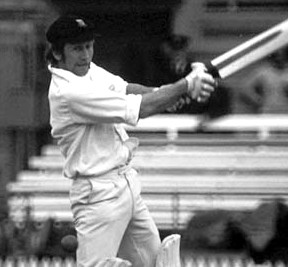
1943Ian Chappell(83 this year)Ian Michael Chappell is an Australian commentator and former cricketer.
1961Cindy Herron(65 this year)Cynthia Ann Herron, professionally known as Cindy Herron and sometimes credited as Cindy Herron–Braggs, is an American singer and actress.
932Al-Mu'izz li-Din AllahAbu Tamim Ma'ad al-Mu'izz li-Din Allah was the fourth Fatimid caliph and the 14th Ismaili imam, reigning from 953 to 975.
1637Sébastien LeclercSébastien Leclerc or Le Clerc was an artist from the French province of the Three Bishoprics.
1750Cuthbert CollingwoodVice-Admiral of the Red Cuthbert Collingwood, 1st Baron Collingwood was a Royal Navy officer who served in the American War of Independence and French Revolutionary and Napoleonic Wars.
1774Johnny AppleseedJohn Chapman, better known as Johnny Appleseed, was an American pioneer nurseryman who introduced trees grown with apple seeds to large parts of Pennsylvania, Ohio, Indiana, Illinois, and the Canadian province of Ontario, as well as the northern counties of West Virginia.
1792William HobsonCaptain William Hobson was a Royal Navy officer and colonial administrator who served as the first governor of New Zealand from 1841 to 1842.
1865Archibald ButtArchibald Willingham DeGraffenreid Clarendon Butt was an American Army officer and aide to presidents Theodore Roosevelt and William Howard Taft.
1892Robert Staughton LyndRobert Staughton Lynd was an American sociologist and professor at Columbia University, New York City.
1895Jürgen StroopJürgen Stroop was a German SS commander and perpetrator of the Holocaust during the Nazi era, who served as SS and Police Leader in occupied Poland and Greece from 1942–1943 and 1943–1944.
1898George GershwinGeorge Gershwin was an American composer and pianist whose compositions spanned jazz, popular and classical music.
1901George RaftGeorge Raft was an American film actor and dancer identified with portrayals of gangsters in crime melodramas of the 1930s and the 1940s. A stylish leading man in dozens of movies, Raft is remembered for his gangster roles in Quick Millions (1931) with Spencer Tracy, Scarface (1932) with Paul Muni, Each Dawn I Die (1939) with James Cagney, Invisible Stripes (1939) with Humphrey Bogart, and Billy Wilder's comedy Some Like It Hot (1959) with Marilyn Monroe, Tony Curtis and Jack Lemmon; and as a dancer in Bolero (1934) with Carole Lombard and a truck driver in They Drive by Night (1940) with Ann Sheridan, Ida Lupino and again with Bogart.
1913Frank BrimsekFrancis Charles "Mr. Zero" Brimsek was an American professional ice hockey player.
1914Jack LaLanneFrancois Henri "Jack" LaLanne was an American fitness and nutrition guru and motivational speaker.
1927Robert CadeJames Robert Cade was an American physician, university professor, research scientist and inventor.
1930Joe BrownJoseph Brown was an English mountaineer who was regarded as an outstanding pioneer of rock climbing during the 1950s and early 1960s. Together with his early climbing partner, Don Whillans, he was one of a new breed of British post-war climbers who came from working class backgrounds in contrast to the upper and middle class professionals who had dominated the sport up to the Second World War.
1932Vladimir VoinovichVladimir Nikolayevich Voinovich was a Russian writer and former Soviet dissident, and the "first genuine comic writer" produced by the Soviet system.
1936Winnie Madikizela-MandelaNomzamo Winifred Zanyiwe Madikizela-Mandela, also known as Winnie Mandela, was a South African politician, anti-apartheid activist, and second wife of Nelson Mandela.
1937Valentin PavlovValentin Sergeyevich Pavlov was a Soviet official who became a Russian banker following the dissolution of the Soviet Union.
1942Gloria E. AnzaldúaGloria Evangelina Anzaldúa was an American philosopher and scholar of Chicana feminism, cultural theory, and queer theory.
1948Vladimír Remek(78 this year)Vladimír Remek is a Czech politician and diplomat, as well as a former cosmonaut and military pilot.
1949Wendy SaddingtonWendy June Saddington, also known as Gandharvika Dasi, was an Australian blues, soul and jazz singer, and was in the bands Chain, Copperwine and the Wendy Saddington Band.
1956Steve Butler(70 this year)Steve Butler is an American former auto racing driver.
Quote of the Day
“Once upon a midnight dreary, while I pondered, weak and weary.” — Edgar Allan Poe, The Raven and Other Poems
September 26 History Quiz
In which year did Einstein publish his Special Theory of Relativity paper?
1905
Which Soviet officer prevented nuclear war by identifying a satellite warning as a false alarm in 1983?
Petrov
Who was the first U.S. Secretary of State, appointed by George Washington?
Every event on this page was picked by hand from the historical record, written up as a news report, and checked against its source. Photographs are matched to the event they illustrate and verified before they are used. Sources are linked on each story.


 “My Heart Has A Mind Of Its Own”,
 “Ain't No Mountain High Enough”,
 Love Story, Erich Segal
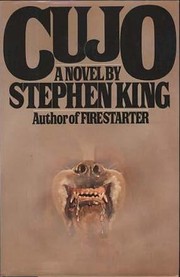 Cujo, Stephen King
 “End Of The Road (From "Boomerang")”,
  Where Is Joe Merchant?, Jimmy Buffett
 Dark Slayer, Christine Feehan
 The Girl in the Spider's Web, David Lagercrantz
 “WAP”,
  All the Devils Are Here, Louise Penny