Our front page for September 9 — written and set by The Yesterday Times from the events below. Not an archival document.
Day of the year
252
Days left in 2026
113
In 2026 it falls on a
Wednesday
Star sign
Virgo
Birthstone
Sapphire
On September 9 in 1957, 69 years ago, Eisenhower Signs Civil Rights Act, First Since Reconstruction; Thurmond Filibuster Fails. This page reports 11 stories from the date, 25 people born on this day.
The stories in full
White House Beat
1957 — Eisenhower Signs Civil Rights Act, First Since Reconstruction; Thurmond Filibuster Fails
1957 law creates Civil Rights Commission and Justice Department division after Senate removes voting protections.
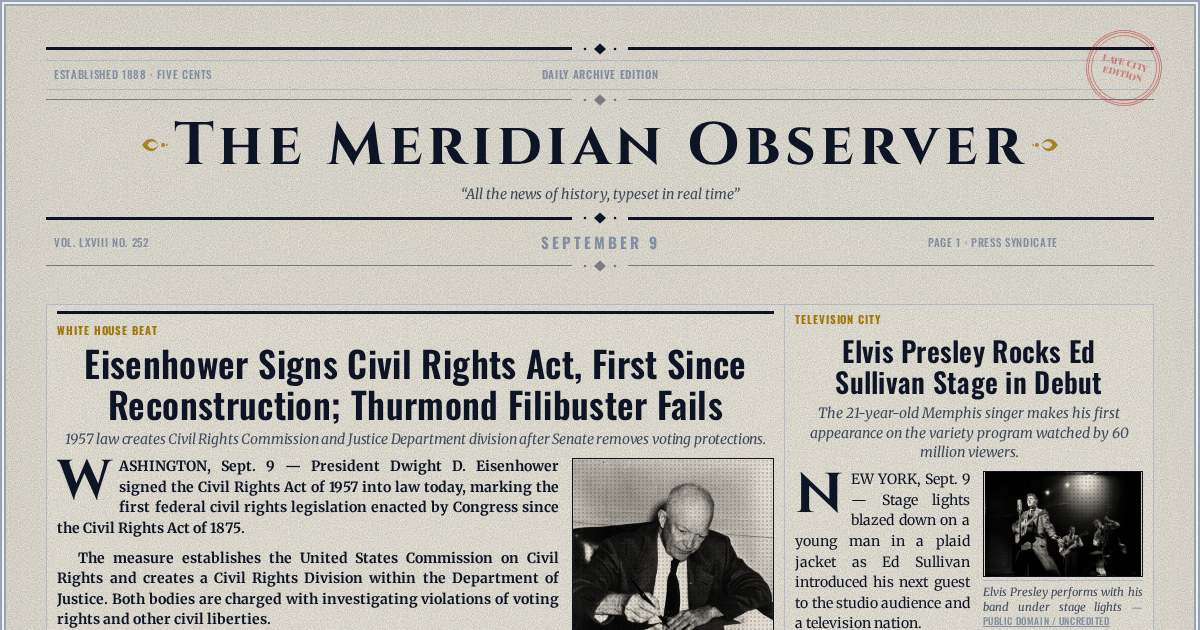
WASHINGTON, Sept. 9 — President Dwight D. Eisenhower signed the Civil Rights Act of 1957 into law today, marking the first federal civil rights legislation enacted by Congress since the Civil Rights Act of 1875.
The measure establishes the United States Commission on Civil Rights and creates a Civil Rights Division within the Department of Justice. Both bodies are charged with investigating violations of voting rights and other civil liberties.
The bill reached the President's desk only after Senator Strom Thurmond of South Carolina concluded the longest one-person filibuster in Senate history. Thurmond spoke for 24 hours and 18 minutes in an unsuccessful effort to block the legislation.
Opponents succeeded in weakening the bill through two key amendments. The Anderson–Aiken amendment and the O'Mahoney jury trial amendment stripped out stringent voting protection clauses that civil rights advocates had sought.
Eisenhower, who had called for civil rights legislation in his 1957 State of the Union address, signed the measure at his desk in the White House.
The Civil Rights Act of 1957 was the first federal civil rights law passed by Congress since the Civil Rights Act of 1875.
President Dwight D. Eisenhower signed the bill into law on September 9, 1957.
The act established the United States Commission on Civil Rights and the United States Department of Justice Civil Rights Division.
Senator Strom Thurmond conducted the longest one-person filibuster in Senate history during debate over the act.
Opponents removed stringent voting protection clauses via the Anderson–Aiken amendment and the O'Mahoney jury trial amendment.
1956 — Elvis Presley Rocks Ed Sullivan Stage in Debut
The 21-year-old Memphis singer makes his first appearance on the variety program watched by 60 million viewers.
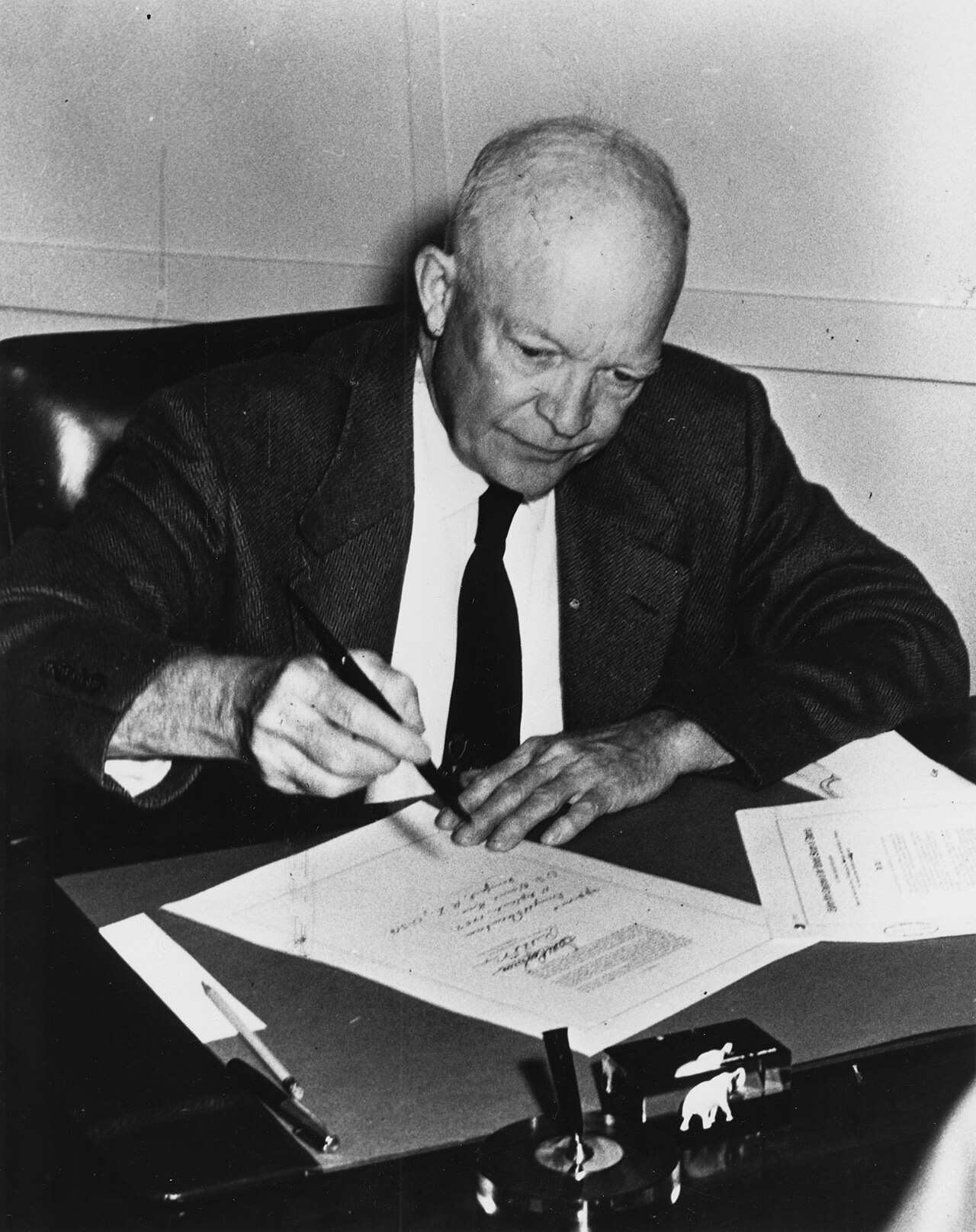
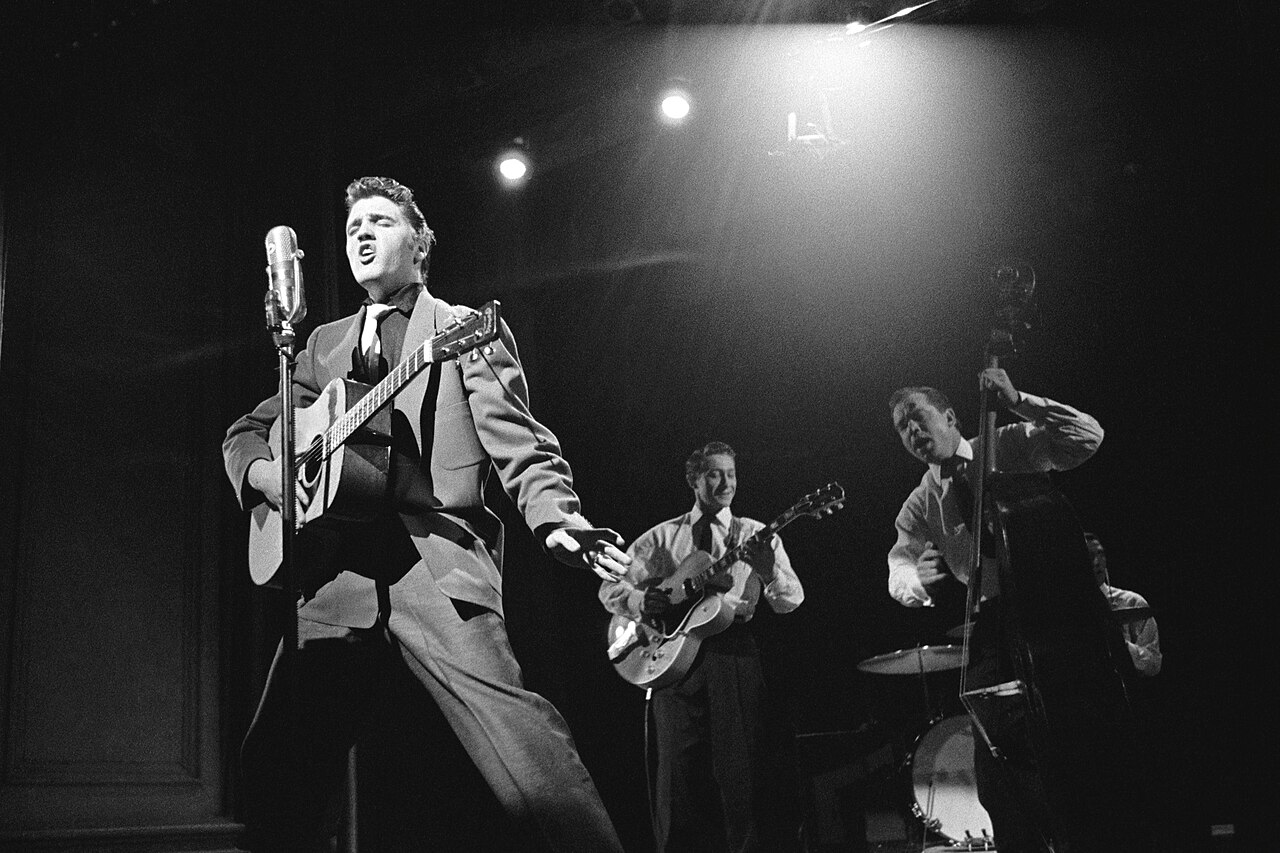
Elvis Presley performs with his band under stage lights — Uncredited
NEW YORK, Sept. 9 — Stage lights blazed down on a young man in a plaid jacket as Ed Sullivan introduced his next guest to the studio audience and a television nation.
Elvis Presley, the 21-year-old rock and roll singer from Memphis, made his first appearance on "The Ed Sullivan Show" tonight, performing with his band before an estimated 60 million viewers. The broadcast marks Presley's debut on the CBS variety program that has launched countless American careers.
Sullivan, whose show has become a Sunday night institution since its 1948 debut, had previously booked Presley for an appearance last January but withdrew the invitation after the singer's controversial performance on "The Milton Berle Show." Network pressure and Presley's rising record sales brought the booking back.
Presley performed "Don't Be Cruel," "Love Me Tender," and "Ready Teddy" during his segment. Cameramen were instructed to shoot him only from the waist up, a precaution network officials imposed after his hip-shaking televised performances drew protests from viewers.
The appearance caps a year that has seen Presley dominate record charts and concert halls across the country.
Elvis Presley appears on The Ed Sullivan Show for the first time.
1971 — John Lennon's 'Imagine' Album Released, Reaches Number One on Both Sides of Atlantic
The 1971 solo LP features what is widely considered Lennon's signature song.
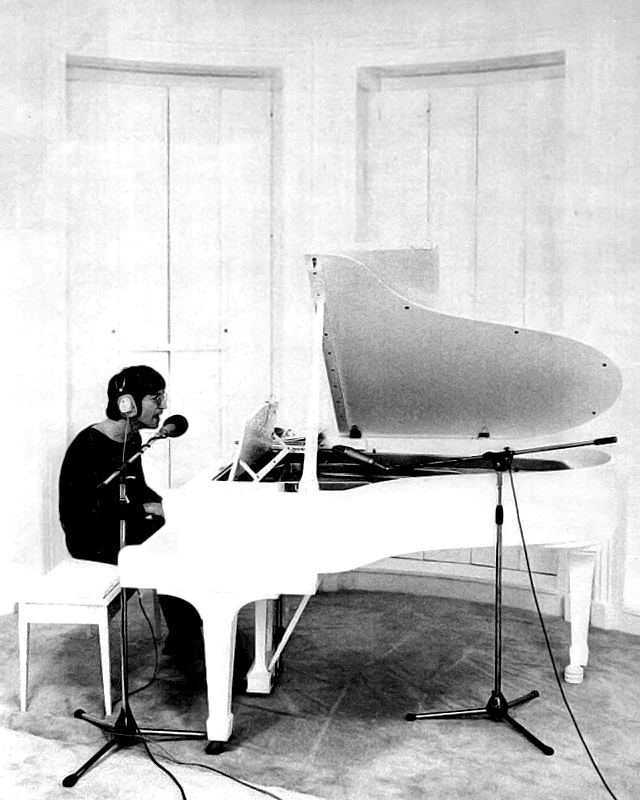
Lennon records at a white grand piano in an all-white room — Peter Fordham
LONDON, Sept. 9 — A new recording by the most commercially successful songwriter of the rock era has entered release today with immediate chart impact and the weight of artistic ambition behind it.
"Imagine," the second solo album by John Lennon, was released September 9, 1971, on Apple Records. The LP has already reached number one on both the UK Albums Chart and the US Billboard 200, according to figures released by the label.
Lennon co-produced the record with Yoko Ono and Phil Spector, the producer known for his "Wall of Sound" technique. Recording sessions took place at Ascot Sound Studios in Lennon's Tittenhurst Park estate, at EMI Recording Studios in London, and at the Record Plant in New York City.
The supporting musicians include George Harrison on guitar, Nicky Hopkins on keyboards, Klaus Voormann on bass, and drummers Alan White and Jim Keltner. Harrison's participation marks the most substantial collaboration between the former Beatles bandmates since the group's dissolution in 1970.
The title track, "Imagine," is already widely considered Lennon's signature song. The album's commercial performance matches that critical assessment.
Imagine was released on 9 September 1971 by Apple Records.
The album was co-produced by John Lennon, Yoko Ono and Phil Spector.
George Harrison, Nicky Hopkins, Klaus Voormann, Alan White and Jim Keltner performed on the album.
Recording took place at Ascot Sound Studios, EMI Recording Studios and the Record Plant in New York City.
The title track 'Imagine' is widely considered Lennon's signature song.
2015 — Elizabeth II Becomes Longest-Reigning British Monarch
Elizabeth, 25 when she acceded in 1952, has now reigned 70 years and 214 days, outlasting Victoria's 63 years and 216 days.
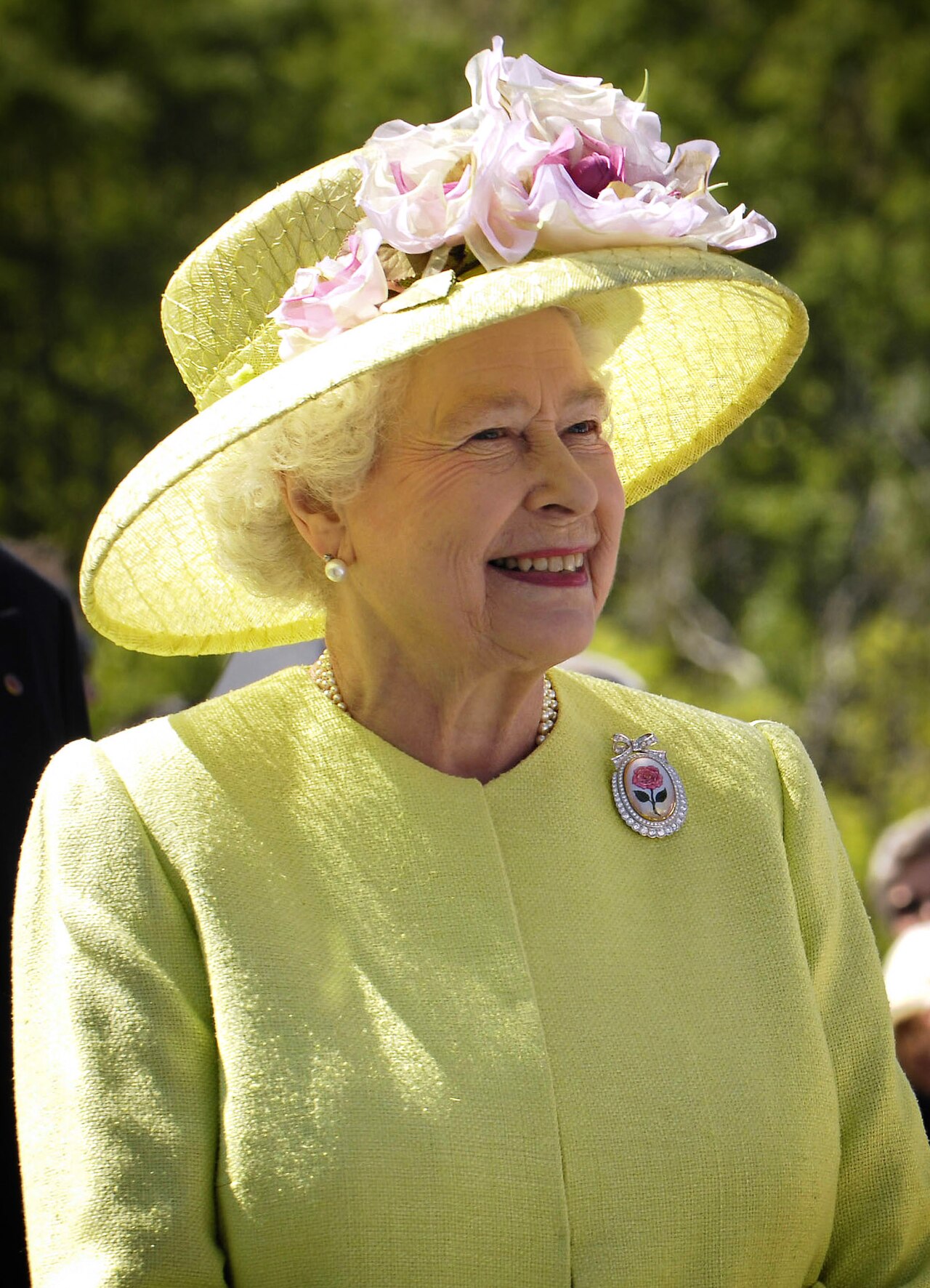
the Queen wears a lime coat and floral hat at a garden party — Bill Ingalls
LONDON, Sept. 9 — In the long arc of British monarchy, a reign that began in the age of Churchill and ration books has today outlasted every other.
Queen Elizabeth II became the longest-reigning monarch of the United Kingdom today, surpassing the record held by her great-great-grandmother Queen Victoria. Elizabeth's reign has reached 70 years and 214 days, exceeding Victoria's 63 years and 216 days.
The Queen came to the throne on February 6, 1952, at age 25, following the death of her father, King George VI.
Elizabeth II's reign of 70 years and 214 days is the longest of any British monarch.
Her reign is the second-longest of any sovereign state in history.
She became queen on 6 February 1952 at age 25 upon the death of her father, King George VI.
Elizabeth II was queen regnant of 32 sovereign states during her lifetime and monarch of 15 realms at her death.
She surpassed the previous record held by her great-great-grandmother Queen Victoria, who reigned 63 years and 216 days.
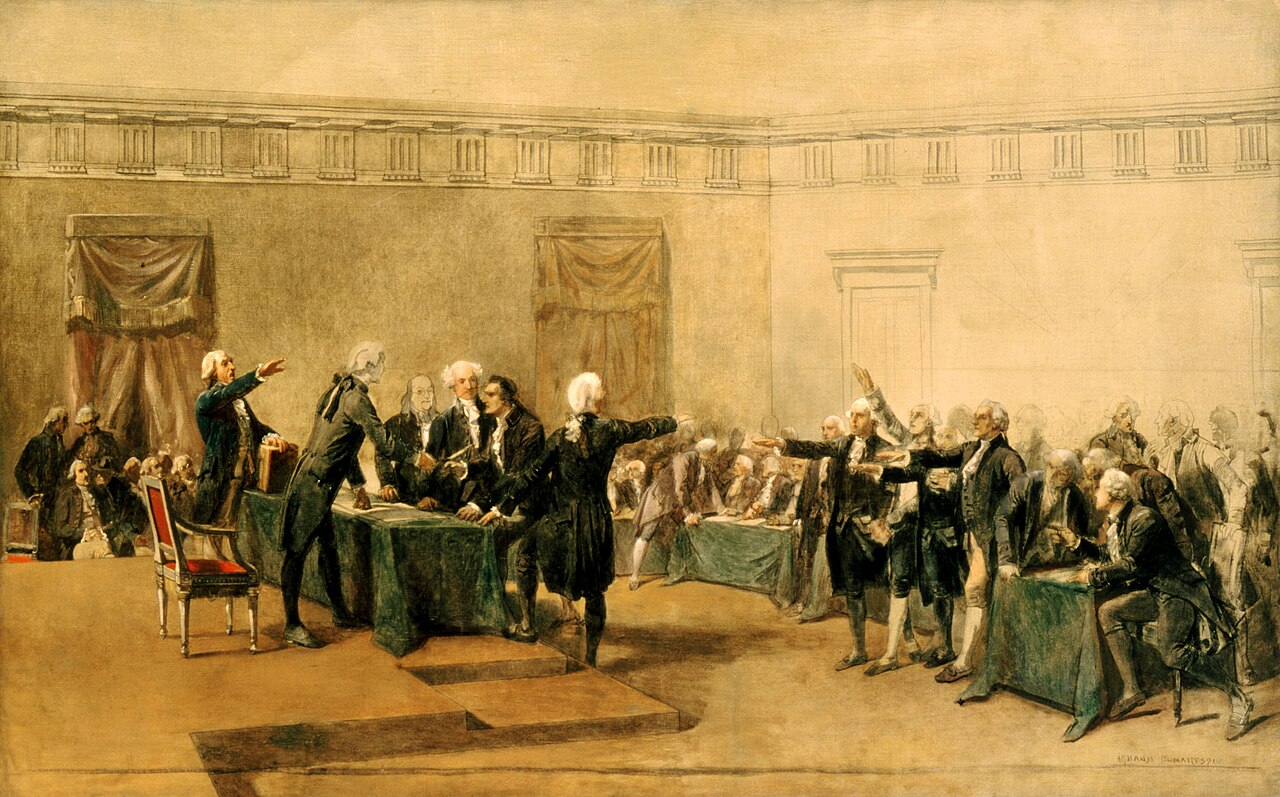
PHILADELPHIA, September 9 — John Hancock, president of the Continental Congress, put his name to the resolution that fixed upon "the United States" as the proper style for this confederation of American provinces.
The delegates, sitting in their chamber at the State House, approved the measure without dissent. Heretofore the several colonies had styled themselves in sundry ways — as "United Colonies" or by their separate names — but henceforth they shall be known collectively as the United States of America.
The vote settles upon a permanent designation for the union that declared its independence from Great Britain in July past. The delegates have ordered that this style govern all public acts and correspondence.
The Continental Congress officially names its union of states the United States.
1588 — Cavendish Completes First Planned Circumnavigation
The Desire enters Plymouth after sailing round the globe by design.
PLYMOUTH, September 9 — Thomas Cavendish, commanding the Desire, has become the first mariner to complete a circumnavigation planned as such from its outset, entering this harbor today two years after his departure.
His voyage follows that of Drake, who rounded the world by necessity and fortune.
Thomas Cavendish in his ship Desire enters Plymouth and completes the first deliberately planned voyage of circumnavigation.
Scotland's king falls in battle, ending his nation's part in the continental war.
LONDON, September 9 — James IV, King of Scots, was defeated and killed this day at the Battle of Flodden, breaking Scotland's power and ending her involvement in the War of the League of Cambrai. His body was found among the slain near the royal banner. Queen Catherine has received the news at Richmond. The northern borders await word of reprisal.
James IV of Scotland is defeated and dies in the Battle of Flodden, ending Scotland's involvement in the War of the League of Cambrai.
1493 — Columbus Departs Cadiz With 17 Ships and 1,200 Men for Second Voyage to Indies
The great fleet sails at dawn on a mission of colonization and conversion.
CADIZ, September 9 — Seventeen ships rode at anchor in this harbor at first light, their sails filling as Christopher Columbus led 1,200 men forth on his second voyage to the western lands.
The Admiral of the Ocean Sea commands a far greater force than on his first crossing.
Christopher Columbus, with 17 ships and 1,200 men, sails on second voyage from Cadiz.
1499 — Lisbon Hails Da Gama; Sea Route to Spice Lands Opened
Two years after departing, the explorer's fleet brings word that Cape passage yields Calicut's riches.
LISBON, September 9 — The pepper trade shall nevermore pass through the infidel's hands. The carracks rode at anchor in the river Tagus, hulls groaning with cinnamon, cloves, and pepper worth sixty times their weight in gold. Merchants crowded the quays, counting the days until the next fleet sails. King Manuel has ordered a Te Deum at the cathedral for Sunday next.
The citizens of Lisbon celebrate the triumphal return of the explorer Vasco de Gama, completing his two-year journey around the Cape of Good Hope to India.
1993 — PLO Recognizes Israel After 45 Years of Rejection
The Palestine Liberation Organization officially recognizes Israel as a legitimate state.
The Palestine Liberation Organization has formally recognized Israel as a legitimate state. The recognition came through letters exchanged with Israeli counterparts via Norwegian mediators. The letters omitted Jerusalem, borders, and refugees but affirmed Israel's right to exist. For the PLO, this marked renunciation of its founding charter calling for Israel's destruction. For Israel, it fulfilled Prime Minister Rabin's precondition for Palestinian self-rule. Yasser Arafat signed the letter.
Israeli–Palestinian peace process: The Palestine Liberation Organization officially recognizes Israel as a legitimate state.
1850 — California Wins Statehood; 31st Star Joins Flag as Compromise Crisis Resolves
California is admitted as the thirty-first U.S. state.
WASHINGTON, September 9 — President Millard Fillmore this day affixed his signature to the bill that makes California the thirty-first state of the Union, resolving in one stroke the territorial question that has convulsed Congress since the Mexican war's end.
The admission carries a single condition: California enters as free soil. The gold-rush territory, seized in 1848, drafted its constitution without slavery and elects its officers under that document. Southern senators, demanding protection for bondsmen in the Mexican cession, have blocked statehood eighteen months.
Senator Henry Clay's omnibus, broken into separate bills, yielded this compromise.
California is admitted as the thirty-first U.S. state.
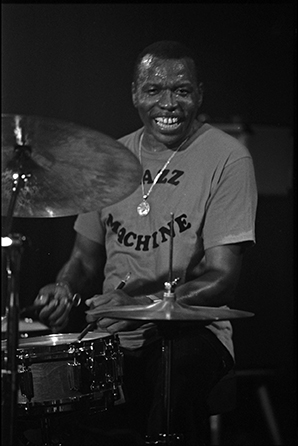
1927Elvin JonesElvin Ray Jones was an American jazz drummer of the post-bop era.
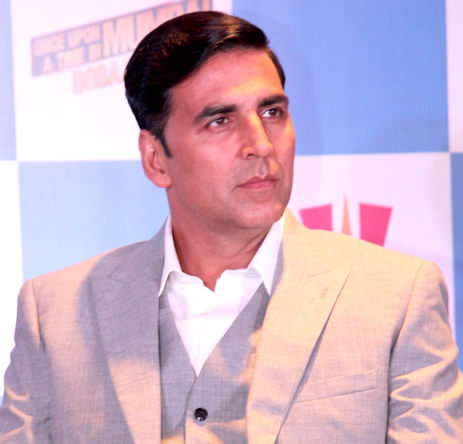
1967Akshay Kumar(59 this year)Akshay Hari Om Bhatia, known professionally as Akshay Kumar, is an Indian actor and film producer working in Hindi cinema.
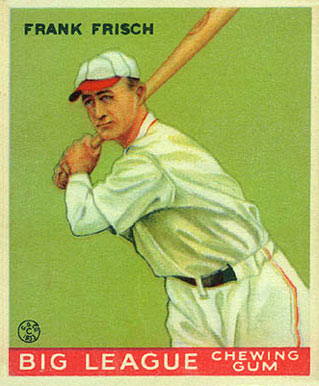
1898Frankie FrischFrank Francis Frisch, nicknamed "the Fordham Flash" or "the Old Flash", was an American professional baseball second baseman and manager.
1954Walter DavisWalter Pearl Davis was an American professional basketball player.
1971Henry Thomas(55 this year)Henry Jackson Thomas is an American actor.
1711Thomas HutchinsonThomas Hutchinson was an American merchant, politician, historian, and colonial administrator who repeatedly served as governor of the Province of Massachusetts Bay in the years leading up to the American Revolution.
1855Houston Stewart ChamberlainHouston Stewart Chamberlain was a British-German-French philosopher.
1877James AgateJames Evershed Agate was an English diarist and theatre critic between the two world wars.
1878Sergio OsmeñaSergio Osmeña Sr. was a Filipino lawyer and politician who served as the fourth president of the Philippines from 1944 to 1946 and as the first vice president of the Philippines from 1935 to 1944.
1887Alf LandonAlfred Mossman Landon was an American oilman and politician who served as the 26th governor of Kansas from 1933 to 1937.
1894Arthur FreedArthur Freed was an American lyricist and a Hollywood film producer.
1911Paul GoodmanPaul Goodman was an American writer and public intellectual best known for his 1960s works of social criticism.
1926Yusuf al-QaradawiYusuf al-Qaradawi was an Egyptian Islamic scholar based in Doha, Qatar, and chairman of the International Union of Muslim Scholars.
1927Tatyana ZaslavskayaTatyana Ivanovna Zaslavskaya was a Russian economic sociologist and a theoretician of perestroika.
1931Margaret TyzackMargaret Maud Tyzack was an English actress.
1934Sonia Sanchez(92 this year)Sonia Sanchez is an American poet, writer, and professor.
1949Susilo Bambang Yudhoyono(77 this year)Susilo Bambang Yudhoyono, commonly referred to as SBY, is an Indonesian politician and retired military officer who served as the sixth president of Indonesia from 2004 to 2014 and the second president from the military after Suharto.
1949Joe Theismann(77 this year)Joseph Robert Theismann is an American former professional football player, sports commentator, corporate speaker, and restaurateur.
1951Tom Wopat(75 this year)Thomas Steven Wopat is an American actor and singer.
1960Bob Stoops(66 this year)Robert Anthony Stoops is an American former football coach who was the head football coach at the University of Oklahoma from 1999 through the 2016 season, and on an interim basis during the 2021 Alamo Bowl.
1968Julia Sawalha(58 this year)Julia Sawalha is an English actress.
1974Marcos Curiel(52 this year)Marcos Curiel is an American musician.
1974Shane Crawford(52 this year)Shane Barry Crawford is a former Australian rules football player, television media personality and author.
1976Mattias Öhlund(50 this year)Kenneth Mattias Öhlund is a Swedish former professional ice hockey player who was a defenceman in the National Hockey League (NHL) for the Vancouver Canucks and Tampa Bay Lightning.
1982Graham Onions(44 this year)Graham Onions is an English former cricketer.
Quote of the Day
“There is nothing either good or bad, but thinking makes it so.” — William Shakespeare, Hamlet
September 9 History Quiz
Which U.S. President signed the Civil Rights Act of 1957 on September 9?
Dwight D. Eisenhower
Which legendary singer made his first appearance on The Ed Sullivan Show on September 9, 1956?
Elvis Presley
In what year did California become the 31st U.S. state on September 9?
Every event on this page was picked by hand from the historical record, written up as a news report, and checked against its source. Photographs are matched to the event they illustrate and verified before they are used. Sources are linked on each story.


 The Arrangement, Elia Kazan
 “Hangin' Tough”,
  Clear and Present Danger, Tom Clancy
 “Gangsta's Paradise (From "Dangerous Minds")”,
  From Potter's Field, Patricia Cornwell
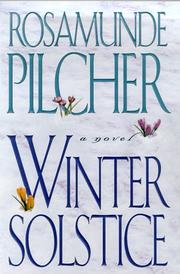 Winter Solstice, Rosamunde Pilcher
 “Despacito”,
  Seeing Red, Sandra Brown
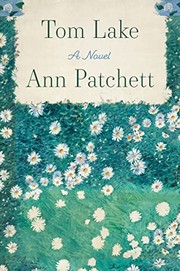 Tom Lake, Ann Patchett